


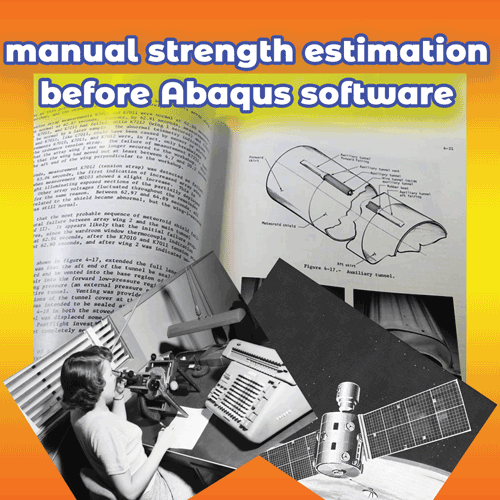
How NASA Did FEA Without Computers: The Astronautic Structures Manual
I used to ask myself a terrifying question: Around 1970, NASA performed its structural calculations manually. Without any computers! Without simulation software like Abaqus, ANSYS, or LS-DYNA. Was it even possible?
To be honest, as a modern design and simulation engineer, I could not imagine what went through an astronaut’s mind during launch. Knowing what I know today about structural complexities, the idea of trusting a spacecraft built without Finite Element Analysis (FEA) seemed funny, yet deeply scary. I always told myself: “My God, without FEA? I would never dare to become an astronaut.”
That was until I discovered a hidden gem in aerospace engineering: The NASA Technical Memorandum on Manual Strength Estimation.
The NASA Astronautic Structures Manual
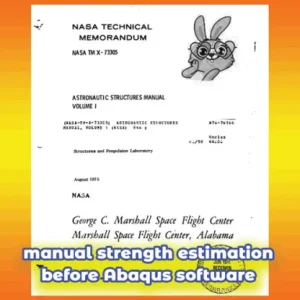
When I finally dug into how NASA actually estimated structural strength by hand, my skepticism turned into sheer amazement. NASA published a highly comprehensive, 3-volume document—the NASA Astronautic Structures Manual—which served as the ultimate set of methods for calculating aerospace validity manually.
What surprised me the most was the accuracy. Contrary to my expectations, these manual methods yielded incredibly precise results for complex structures. They were so rigorous that I was finally convinced: Yes, I could have trusted their papers in the 70s. This desktop reference details calculation methods and their development history, making it a goldmine for engineers in any industry.
why Modern Engineers Need Manual Strength Estimation
You might wonder: If we have Abaqus today, why do we need 40-year-old NASA documents? The answer lies in one of the most critical aspects of modern simulation: Verification and Validation (V&V).
Colorful contour plots in Abaqus can be deceiving if the fundamental physics are wrong. Design engineers, R&D offices, professors, and researchers must keep these NASA documents in their archives for two main reasons:
Initial Estimation: Quickly sizing up a structure before spending hours building an FEA mesh.
FEA Verification and Validation (V&V): Proving that your computer results are actually correct.
Verification ensures your FEA model solves the mathematical equations correctly. Validation ensures those equations accurately represent real-world physical behavior. By comparing your Abaqus results against the robust analytical methods in the NASA manual, you build undeniable confidence in your simulations.
(For a deeper dive into this philosophy, read our dedicated article on The Critical Role of Analytical Hand Calculations in Modern FEA Validation).
Inside the 3-Volume NASA Strength Estimation Document
This compilation of aerospace strength analysis methods is general enough for most structural projects, yet sophisticated enough to accurately predict failure. It covers both elastic and inelastic stress ranges and serves as an ultimate catalog for Uncertainty Quantification in Finite Element Analysis.
The manual is meticulously divided into eight core sections:
- Section A: General introduction to methods, loads, combined stresses, and interaction curves.
- Section B: Methods for calculating structural strength.
- Section C: Structural stability and buckling.
- Section D: Thermal stresses and heat transfer impacts.
- Section E: Mechanics of Fatigue and Fracture Mechanics.
- Section F: FRP Composites and anisotropic materials.
- Section G: Rotating machinery analysis.
- Section H: Statistical approaches to failure.
Free Download: NASA Astronautic Structures Manual
These three volumes are arguably the best freely available references for the fast calculation of structural strength and stability. Do not hesitate to download, use, and archive them for your next critical R&D project.
Download Volume 1 (PDF)
Download Volume 2 (PDF)
Download Volume 3 (PDF)
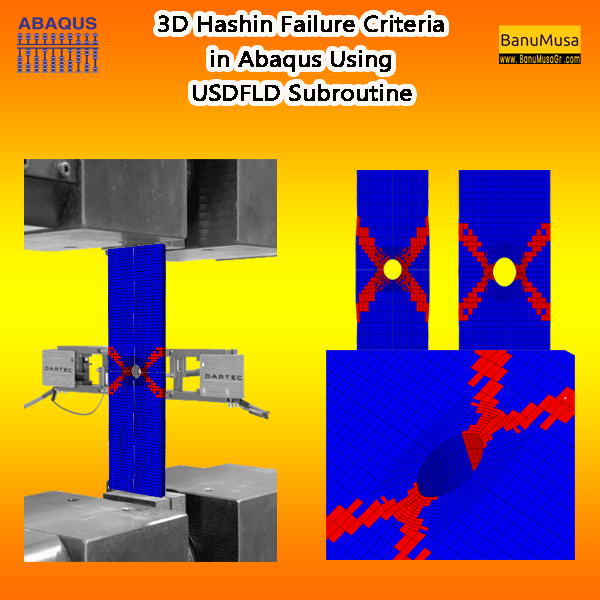
3D Hashin USDFLD Subroutine Failure Criteria for Abaqus

Accelerate Your Engineering Projects with BanuMusa R&D
Struggling with complex simulations, material calibration, or convergence issues? We provide professional solutions to guarantee your R&D success:
- 🚀 FEA & CFD Consultancy: Outsource your toughest structural, thermal, and fluid dynamics challenges to our industry experts.
- 🎓 Technical Abaqus Mentoring: Get 1-on-1 professional guidance to overcome specific modeling bottlenecks and save weeks of trial and error.
- 📚 Abaqus Material Library (MatLib): Skip manual mathematical calibration. Download hundreds of scientifically validated material models instantly.