

The Critical Role of Soil-Structure Interaction (SSI)
Because every building, infrastructure, and heavy industrial facility is inherently grounded, understanding the engineering behavior of soil and its interaction with structural foundations is non-negotiable. Unlike manufactured materials like steel, soil behaves with extreme complexity due to its heterogeneity, non-linear plasticity, and multi-phase nature.
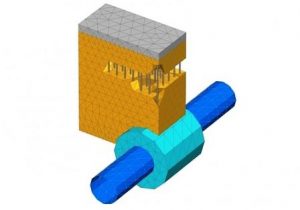
At BanuMusa R&D, we move beyond basic analytical estimations. We leverage high-fidelity Finite Element Analysis (FEA) to investigate the complex stresses, deformations, and potential hazards—such as seismic liquefaction, landslides, and subsidence—affecting structures in contact with the ground. Whether designing deep raft foundations, retaining walls, or earthen dams, a synchronized geotechnical and structural design phase is critical to ensure both safety and cost-efficiency.
Structural & Earthquake Engineering
Proper structural analysis is the backbone of safe civil infrastructure. While traditional static analysis can evaluate the nominal strength of reinforced concrete or steel connections, modern engineering demands rigorous dynamic and seismic evaluations.
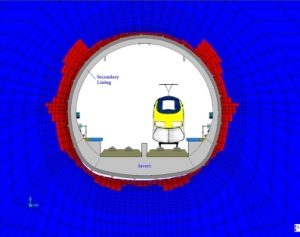
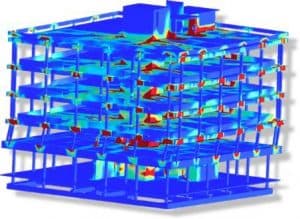
Using Abaqus and LS-DYNA, our team predicts structural responses under extreme transient loads, wind resistance, and seismic vibrations. We implement advanced non-linear material behaviors, including geometric non-linearities and the Concrete Damaged Plasticity (CDP) model, to accurately capture concrete cracking, crushing, and large-scale displacements during severe loading events.
👉 Looking to master concrete simulation? Explore our comprehensive Concrete Modeling in Abaqus Course.
Advanced Geotechnical Engineering & Simulation
Understanding the physical and mechanical properties of the project site is only the first step. To predict ground motion, structural deviations, and material instability with high precision, we utilize advanced computational solvers like PLAXIS, Abaqus, and FLAC. By doing so, we reduce unnecessary design conservatism, saving significant material costs while maintaining stringent safety factors.

Our Core Geotechnical Capabilities include:
- Advanced Constitutive Modeling: Implementation of Soft Soil, Hardening Soil, Mohr-Coulomb, Hoek-Brown, Modified Cam-Clay, and Sekiguchi-Ota models.
- Tunneling & Excavation: 2D/3D simulation of the New Austrian Tunneling Method (NATM) and deep urban excavations.
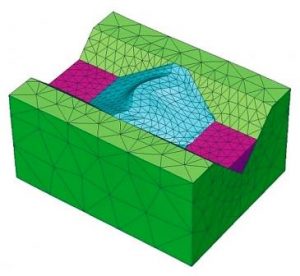
- Bearing Capacity & Foundations: 3D numerical evaluation of strip, raft, and pile foundations under static and dynamic loads.
- Seepage & Groundwater Flow: Transient and steady-state seepage modeling under earthen/concrete dams and sub-shields.
- Retaining Structures: Design and simulation of Geotextile-reinforced soil walls and gravity concrete walls, calculating precise lateral earth pressure distributions.
- Slope Stability: Evaluating the safety factor of dams and complex slopes using the Shear Strength Reduction (SSR) method.
- 👉 Automate your slope stability calculations in Abaqus with our proprietary SlopeSR Geotechnical Plugin.
Software Arsenal
We employ industry-leading computational codes to deliver validated and reliable results:
- Abaqus (Non-linear Structural & SSI)
- PLAXIS 2D / 3D (Geotechnical Engineering)
- LS-DYNA (Explicit Seismic & Impact Dynamics)
- Ansys (Civil Infrastructure)
- FLAC (Advanced Continuum Modeling)