

Advanced Failure Analysis, FMEA, FFS & RBI Consulting Services
Failure analysis is the systematic, engineering-driven process of collecting and analyzing data to determine the exact root cause of a component’s malfunction. According to NACE International, unmitigated corrosion and material degradation alone cost the global industry over $2.5 trillion annually. At BanuMusa R&D, we prevent these catastrophic breakdowns using Simulation-Driven Failure Analysis.
At BanuMusa R&D, we offer Simulation-Driven Failure Analysis. By combining advanced metallurgical inspections with high-end Finite Element Analysis (FEA), Computational Fluid Dynamics (CFD), and analytical frameworks, we determine exactly how and why your equipment failed.
Our multidisciplinary engineering team covers solid mechanics, multiphysics, heat transfer, and manufacturing processes to provide actionable solutions for the most complex industrial malfunctions.
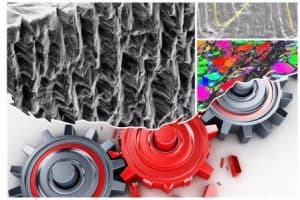
Our Comprehensive Failure Analysis Methodology
A successful root cause analysis goes far beyond looking at a broken part. We utilize a holistic framework integrating global engineering standards:
Step 1: Advanced Inspection & Non-Destructive Testing (NDT)
The foundation of any robust failure analysis is a rigorous physical inspection conducted in accordance with ASTM E2332 (Standard Practice for Investigation and Analysis of Physical Component Failures). We evaluate the failed component for visible damage, wear, pitting, corrosion, overheating, and microscopic crack initiation sites. For operating plants, we implement Risk-Based Inspection (RBI) methodologies to prioritize high-risk equipment. RBI helps in developing an optimized inspection plan that identifies potential failure mechanisms before they lead to unexpected shutdowns.
Step 2: Failure Mode and Effects Analysis (FMEA)
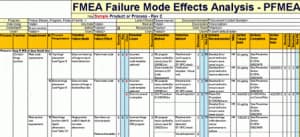
To ensure comprehensive reliability, we conduct FMEA (Failure Mode and Effects Analysis). This systematic, proactive method evaluates a process or product to identify where and how it might fail, assessing the relative impact of different failures. FMEA allows our engineers to pinpoint design flaws or manufacturing defects at the earliest possible stage.

Step 3: Reverse Engineering & Virtual Testing (FEA/CFD)
Physical testing alone cannot always replicate the exact operational loads at the moment of failure. We recreate the failure environment digitally. By running advanced FEA crash, impact, or thermal simulations on the digital twin of your component, we can visualize stress concentrations and residual stresses that led to the fracture.
Failure Analysis by Material Category
Failure Analysis of Metal Materials
Metal components are the backbone of medical and heavy industrial equipment. Fatigue, dynamic impact, and corrosion (such as Hydrogen Induced Cracking) cause rapid deterioration. Our advanced numerical simulations predict High-Cycle and Low-Cycle Fatigue (HCF/LCF), allowing us to redesign metallic components for infinite life. We assess:
-
Weld joint failures and residual stress cracking.
-
Corrosion and environmentally assisted cracking.
-
Cyclic fatigue using Pelamis Fatigue Damage Calculator, fe-safe and MSC-Fatigue.
Failure Analysis of Composite Materials
Composites (FRPs) are highly complex, anisotropic materials. They do not fail like isotropic metals; they exhibit multiple, simultaneous failure modes. A thorough failure analysis must examine:
-
Types of Failure: Identifying fiber breakage, matrix cracking, ply delamination, and fiber-matrix debonding.
-
Manufacturing Defects: Evaluating the presence of voids, fiber misalignment, ply wrinkling, or incorrect volume fractions.
-
Interface & Matrix Properties: Weak interfaces often lead to catastrophic shear failures.
-
Advanced Simulation: We utilize highly advanced progressive damage analysis (PDA) subroutines to predict composite failure. (Want to learn how we do it? Check out our masterclasses on LaRC05 Failure Criterion and 3D Hashin VUMAT).
Elastomers, Plastics & Brittle Materials
From the hysteresis and fatigue of rubber seals to the ballistic shattering of ceramic armors, non-metallic failures require highly specialized physics. We utilize hyperelastic modeling for rubber degradation and specialized damage models like Johnson-Holmquist (JH-2) to analyze high-velocity impact failures in brittle materials.
FEA vs. FMEA: What is the Difference?
A common question in reliability engineering is the difference between FEA (Finite Element Analysis) and FMEA (Failure Mode and Effects Analysis).
- FMEA is a qualitative, proactive risk assessment tool. It identifies what could go wrong (failure modes) and the severity of its impact on the system.
- FEA is a quantitative, numerical simulation tool. It calculates exactly when and where a failure will occur under specific loads (stress, strain, fatigue).
The Synergy: At Banu Musa R&D, we combine both. We use FMEA to identify high-risk components, and then apply FEA to computationally validate and eliminate those risks before manufacturing.
Looking for Similar Engineering Results?
Don't let complex simulation challenges slow down your R&D. Our expert team at BanuMusa R&D is ready to provide tailored, highly accurate FEA and CFD solutions for your specific industry.
Request a Similar Simulation ProjectBanuMusa R&D Case Studies & Specialized Tools
We don’t just talk about failure analysis; we engineer the solutions. Here is a glimpse into our specialized projects and the proprietary training/tools we offer to solve industrial challenges:
Industrial Failure Analysis Projects:
-
Creep & Fatigue Analysis of Gas Turbine Blades: Comprehensive root cause analysis of catastrophic failure in gas turbine components, involving high-temperature creep and thermomechanical fatigue assessment.
-
Failure Analysis of Marine Diesel Engines: Investigating the complex failure modes and structural integrity of critical marine propulsion systems under extreme cyclic loading.
-
Fitness for Service (FFS) Assessment of Spherical Pressure Vessels: Conducted Level 3 FFS evaluations on critical refinery equipment with pitting corrosion to assess localized metal loss and ensure safe continued operation.
-
Fatigue & Static Damage in Chopped Composite Sheets: Identifying micro-mechanical failure initiation and progressive damage in industrial composite components.
-
Fatigue, Impact, & Contact Stress in Rail Joint Region: Advanced FEA assessing rolling contact fatigue and severe stress concentrations in railway infrastructure.
-
Impact Damage Analysis of Composite Plate: Simulation of high-velocity and low-velocity impact degradation on FRP composite structures.
Explore All Engineering Projects →
Specialized Tools & Training Courses:
-
Fitness-for-Service Analysis with Abaqus Course: A complete training package for simulating FFS standards inside the Abaqus environment.
-
Fitness-for-Service Analysis with Signal FFS Course: Master the industry-standard Signal FFS software for rapid Level 1 and Level 2 evaluations.
-
Advanced Failure Analysis of Composite Materials: A comprehensive guide to modeling composite damage using Abaqus and Autodesk Helius PFA.
-
VUMAT Subroutine for Gurson-Tvergaard-Needleman (GTN) Damage Model: Implement advanced void nucleation and ductile fracture models in Abaqus.
-
Rolling Contact Fatigue Analysis of Rail Wheels: An advanced simulation package predicting crack initiation and spalling in UIC60 rail wheels.
-
Pelamis Fatigue Damage Calculator Plugin: Our proprietary Abaqus plugin for calculating structural fatigue life.
-
Abaqus Material Library (MatLib): Our flagship plugin providing engineers with over 1,400 ready-to-use, validated material properties, eliminating calibration errors in FEA.
-
Free Johnson-Cook Calibration Tool: A dedicated Abaqus plugin to streamline the calibration of dynamic failure and high-velocity impact simulations.
Stop Guessing. Start Simulating.
Whether you are dealing with a catastrophic structural collapse, complex composite delamination, or require a Level 3 API-579 FFS assessment, our engineering team provides the definitive answers you need.
- 🚀 Industrial FEA Consultancy: Outsource your root cause analysis to us. We uncover design flaws and optimize your products for maximum reliability.
- 🎓 Technical Mentoring: Need to simulate a complex failure mode in Abaqus yourself? Book a 1-on-1 session with our senior experts.
- 📚 Abaqus Material Library (MatLib): Accurate failure analysis requires accurate material data. Inject +1,400 validated material models directly into your Abaqus/CAE.