

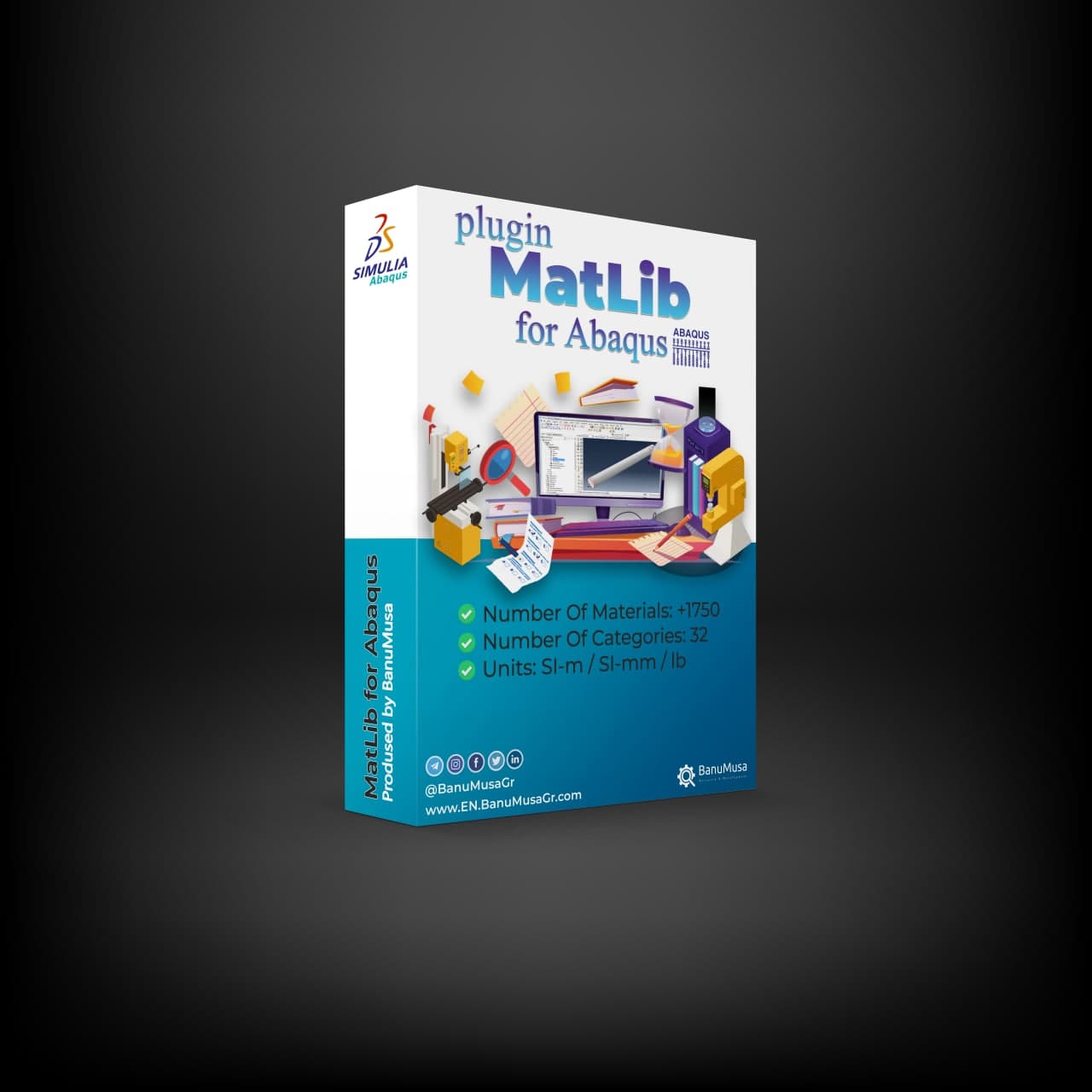


MatLib: The Ultimate Abaqus Material Library Plugin
MatLib Abaqus Material Library
The MatLib Abaqus material library contains various constitutive material data that can be used to define the mechanical behavior of materials in Abaqus simulations.
Supported Material Models
Some of the major material data in MatLib for Abaqus are:
Elastic Material Data:
The simple elastic material data defines the material behavior using elastic modulus and Poisson’s ratio.
Plasticity Material Data:
Plasticity material data that can capture non-linear plastic deformation behavior. MatLib for Abaqus offers both isotropic and kinematic hardening plasticity material data for metal alloys, polymers, concretes, etc.
Viscoelastic Material Data:
Viscoelastic material data account for both elastic and time-dependent viscous behavior. MatLib Abaqus provides both linear and non-linear viscoelastic material data.
Viscoplastic Material Data:
Viscoplastic material data incorporate both rate-dependent plasticity and time-dependent viscous effects.
Damage Material Data:
Damage material data that can simulate material degradation and failure. MatLib for Abaqus offers continuum damage mechanics and fracture mechanics material data for metals, composites, concretes, etc.
Hyperelastic Material Data:
Hyperelastic material data are useful for simulating the non-linear elastic behavior of rubbers and polymers. MatLib for Abaqus offers several hyperelastic material data based on strain energy density functions.
Geomaterials Material Data:
Special material data for soils, rocks, and other geomaterials. MatLib for Abaqus has material data for rocks, soils, concrete, and asphalt.
Material Data for Abaqus Material Models
MatLib for Abaqus provides a comprehensive set of material models to represent the behavior of metals, polymers, composites, soils, biomaterials, and many other material classes. Abaqus FEA Engineers can choose material data based on the material type and intended application of the FEA simulation.
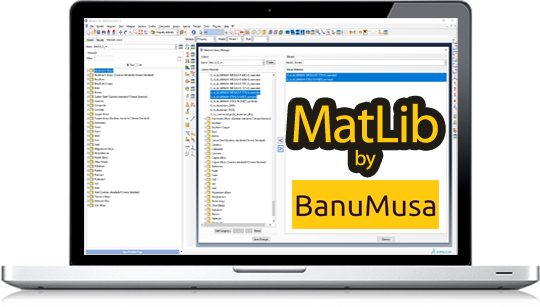
MatLib Abaqus material library is a new plugin providing instant, clickable access to a general library of materials property data across the Abaqus/CAE, saving simulation time, reducing costs, avoiding errors, and increasing simulation accuracy. A single license gives you access to over 1400+ material data.
Why Choose MatLib for Abaqus Simulations?
In advanced Finite Element Analysis (FEA), defining accurate material properties is critical. A single error in density units or yield stress calibration can ruin days of computational time. MatLib acts as your comprehensive Abaqus material database, seamlessly integrating directly into the Abaqus/CAE interface to eliminate human error and save you countless hours.
Key Features of the MatLib Plugin
Developed by the engineering team at BanuMusa R&D, this plugin is tailored for both industrial consultants and academic researchers:
- Extensive Database: Access over 1,400 thoroughly validated material datasets ready to be assigned to your parts.
- Error-Free Unit Systems: Forget manual conversions. MatLib automatically imports properties in your chosen consistent unit system (SI-m, SI-mm, or Imperial/lb).
- Comprehensive Categories: 32 distinct categories including Structural Steels, Aluminum Alloys, Hyperelastic Rubbers, Concrete, Foams, and advanced Composites.
- Advanced Material Models: Fully supports complex Abaqus material behaviors such as Hashin damage, Johnson-Cook plasticity, Mooney-Rivlin, and temperature-dependent properties.
Manual Setup vs. MatLib Integration
Here is why engineering teams and researchers are upgrading their workflow with our Abaqus material library:
| Feature / Workflow | Manual Setup | With MatLib Plugin |
|---|---|---|
| Time to define a complex material | 30 – 60 Minutes | < 10 Seconds |
| Risk of Unit Conversion Errors | High (Especially Density/Yield) | Zero (Automated) |
| Data Reliability | Depends on paper/source hunting | Pre-validated Datasets |
How to Install and Use MatLib
Integration is incredibly simple. Upon purchase, you will receive a straightforward installation guide. Once installed, MatLib appears directly in your Abaqus/CAE top menu toolbar. Simply select your material, choose your unit system, and click import. The properties are instantly generated in your model tree.
🚀 Elevate Your Engineering Research
Are you working on your thesis or a university research project? We support the academic community! Submit your student ID here to receive an exclusive 40% discount on MatLib and all our advanced products.
MatLib Benefits
Special features
MatLib Applications
How does MatLib help the FEA engineer?
- Time savings
- Access to data
- Standardized data format
- Easy comparison of materials
- Reliable data sources
- Updated data
- Complete data sets
- Potential for automation
- Reduced errors
- Compatible with Abaqus material models
Abaqus Material Property Database
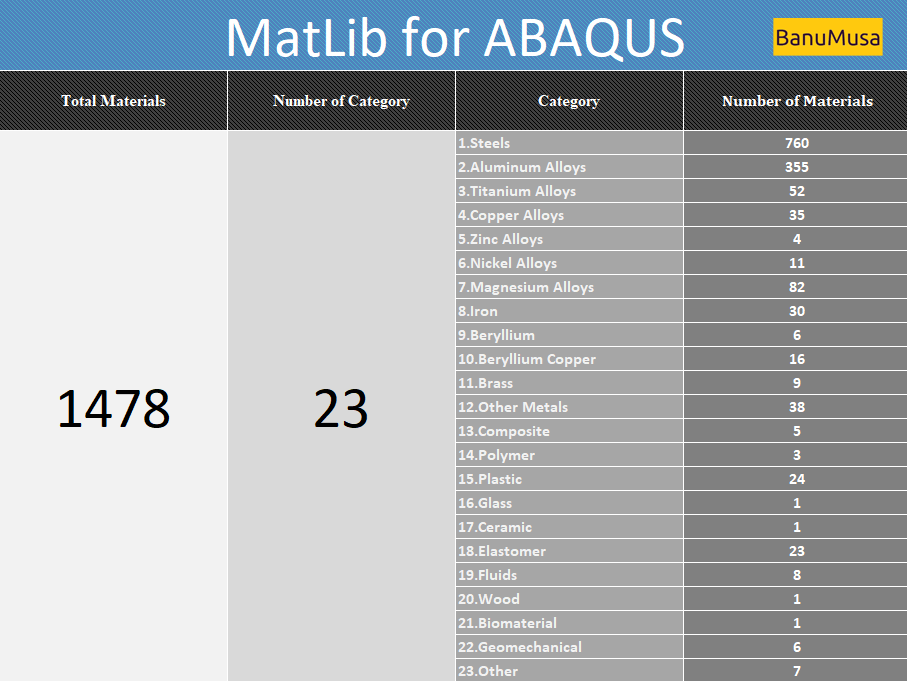
MatLib is a material property database for the Abaqus FEA program. It has a large database of material properties that can be used for simulating the behavior of materials and structures. Some of the main materials and their properties available in MatLib include:
• Steels: Yield stress, ultimate tensile strength, modulus of elasticity, Poisson’s ratio, density, strain hardening behavior, etc. Properties for various types of steel like carbon steel, stainless steel, tool steel, etc.
• Aluminum alloys: Yield stress, ultimate tensile strength, modulus of elasticity, Poisson’s ratio, density, and strain hardening behavior for various aluminum alloys.
• Polymers: Stress-strain curves, tensile properties, modulus of elasticity, Poisson’s ratio, density, and shear modulus for different polymers like PE, PP, PS, nylon, etc.
• Composites: Elastic properties, strength properties, shear properties, fiber and matrix properties for various composite materials like carbon fiber composites, glass fiber composites, etc.
• Concrete: Compressive strength, tensile strength, shear strength, elastic modulus, Poisson’s ratio, density, and stress-strain curves for different grades of concrete.
• Elastomers: Hyperelastic material models and parameters for rubbers, soft plastics, adhesives, sealants, and other elastomers.
• Soils: Cohesion, angle of internal friction, modulus of elasticity, Poisson’s ratio, and density properties for different types of soils.

References
- Supplier datasheets
- Standards and handbooks
- Experimental testing
- Simulation calibration

How to Download MatLib Abaqus Material Library?
To download the MatLib Abaqus materials library, you can proceed in the following two ways:
Academic Discount Program
At BanuMusa R&D, we understand that groundbreaking research requires high-fidelity tools, but academic budgets can often be restrictive. We believe that financial limitations should never compromise the quality of your thesis, publication, or simulation accuracy. To support engineering students, Ph.D. candidates, and academic researchers worldwide, we are proud to offer an exclusive 40% Academic Discount on MatLib.
How to Claim Your Discount
-
Submit Your Details: Fill out the application form below using your official university email address (e.g., .edu, .ac.uk, etc).
-
Verify Your Status: Upload a clear image of your current, valid Student ID card or an official university enrollment letter.
-
Get Your Code: Our team will review your application. Within 24 hours, you will receive a unique, single-use discount code directly in your inbox to apply at checkout.
Full Version
We are developing MatLib. The amount of material data is increasing every day. Now, it has reached 1400+ materials in different material classes. Purchasing this plugin provides 1-year full support. Contact us to learn more.
Examples
Material Database List
Materials Database: Plans & Prices
Money-Back Guarantee

We’re fully confident in the value and reliability of the MatLib Abaqus Material Database. If for any reason you are not completely satisfied, email us at info@BanuMusaGr.com within 48 hours of your purchase for a full refund.
I am text block. Click edit button to change this text. Lorem ipsum dolor sit amet, consectetur adipiscing elit. Ut elit tellus, luctus nec ullamcorper mattis, pulvinar dapibus leo.







nasimky75 –
thanks
Rikko_93 –
it is now under simulation, the result has not out yet, ton of thanks for supporting me
vansh8483 –
thanks
aliakbar.abdollahi001 –
best
Mohamad Khorashad –
Thanks 🙂