
Facebook Twitter Instagram YouTube linkedin
info@BanuMusaGr.com
Login / Register
0 Wishlist
0 Compare
0 items / € 0.00
Facebook Twitter Instagram YouTube linkedin
BanuMusa R&D BanuMusa R&D
  • Consulting Services
  • Products
  • Resources
    • Blog
    • Projects
  • About Us
    • Contact Us
    • Our Team
    • Our Partners
    • Careers
Free Mentoring
Menu
BanuMusa R&D
0 items / € 0.00
VUMAT JHB JH-2 ceramic model- Implementing Johnson-Holmquist model in Abaqus - JH-2 damage model VUMAT
Watch video
HomeShopAbaqusAbaqus Subroutines Abaqus VUMAT JHB and JH-2 Ceramic Model
Previous product
Step-By-Step Ansys Fluent Non Dimensional Laminar Flow Simulation Guide
Step-By-Step Ansys Fluent Non Dimensional Laminar Flow Simulation Guide € 55.00
Back to products
Next product
concrete modeling in abaqus tutorial video
Mastering Concrete Modeling in Abaqus: A Comprehensive Course € 425.00

Abaqus VUMAT JHB and JH-2 Ceramic Model

€ 199.00

In Abaqus VUMAT JHB and JH-2 Ceramic Model tutorial course, you will learn how to use Built-in VUMAT subroutines in Abaqus to predict brittle materials (e.g. ceramic materials) damage using Johnson, Holmquist, and Beissel (JHB) and Johnson-Holmquist (JH-2) ceramic model. Also, 5 practical workshops show you how to define and use the subroutine, how to configure the model in Abaqus CAE, and how to visualize the results. There is also a JH-2 VUMAT subroutine Fortran file in this CAE package. In addition to the tutorial video, the Abaqus workshop files, & JH-2 VUMAT subroutine will be provided to you so that nothing will remain unclear. Also, all course includes free online 24/7 online tutoring after purchase.

Abaqus tutorial video (*.mp4)
Lecture notes (PDF)
Abaqus workshop files (*.cae, *.inp, *.jnl, *.odb)
 JH-2 Fortran VUMAT subroutine run on Windows or Linux

15-day money-back guarantee
  Free 24/7 online mentoring

somdn_product_page
Compare
Add to wishlist
SKU: 003 Categories: Abaqus Tips and Tricks, Abaqus, Abaqus Subroutines, Training courses, Tutorial
Share
Facebook Twitter Email Pinterest linkedin Odnoklassniki WhatsApp WhatsApp VK Telegram
close
Products
  • Bending Pipe plugin interface acting as an advanced pipeline modeling software in Abaqus Bending Pipe Plugin for Abaqus € 1,365.79 Original price was: € 1,365.79.€ 685.00Current price is: € 685.00.
  • Design and Analysis of Composite Overwrapped Pressure Vessels Course banumusa wcm plugin Design and Analysis of Composite Overwrapped Pressure Vessels Course € 425.00
  • Description
  • Additional information
  • Reviews (0)
  • Payment & Support
  • Content
Description
How to use built-in VUMAT subroutine for the Johnson, Holmquist, and Beissel (JHB) And Johnson-Holmquist (JH-2) ceramic model in Abaqus?

Abaqus VUMAT for the JHB and JH-2 Ceramic Model

Abaqus Tips & Tricks

VUMAT for the JHB and JH-2 Ceramic Model in ABAQUS

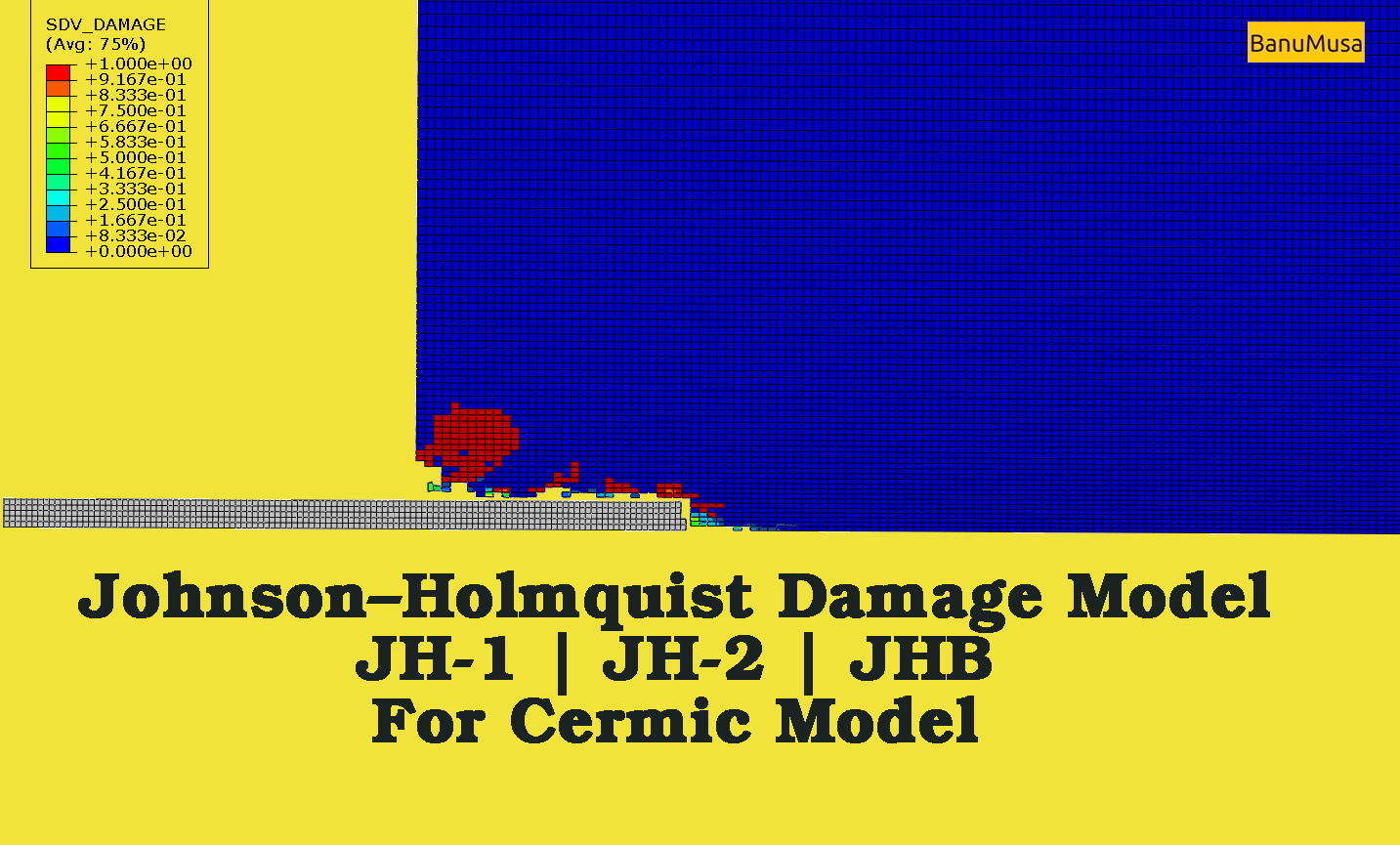
The purpose of the Abaqus VUMAT JHB and JH-2 Ceramic Model tutorial course is to learn, how to use Johnson-Holmquist (JH-2) and Johnson, Holmquist, and Beissel (JHB) built-in material models to simulate the failure behavior of brittle materials like ceramics.

With the release of Abaqus/Explicit 6.10 and later, two constitutive models for ceramics and other brittle materials are included as built-in material VUMATs:

  • Johnson, Holmquist, and Beissel (JHB)
  • Johnson and Holmquist (JH-2)

These models can be used to simulate the behavior of materials under high strain rate loading conditions, such as impacts.

Implementing Johnson-Holmquist Damage Models for Brittle Ceramics in Abaqus

The JHB and JH-2 models are continuum damage mechanics models used to simulate the failure of brittle ceramic materials. They are implemented in a VUMAT (user material) subroutine for Abaqus simulations to model the nonlinear behavior and damage of ceramics.

The JHB and JH-2 models are best suited for modeling the failure of brittle ceramic materials with linear elastic behavior up to failure and little or no plasticity. The VUMAT JHB and JH-2 ceramic models implement the constitutive model in Abaqus by calculating stresses, evolving damage, updating stiffness, and passing results to Abaqus at each increment.

To implement Johnson-Holmquist damage models for brittle ceramics in Abaqus, we suggest two solutions:

  1. Using the built-in material model in Abaqus
    You have three choices for this. The JH-1, JH-2, and JHB models. All three models can be used in Abaqus without the need to write a VUMAT subroutine by defining a series of parameters in the Abaqus input file (*.inp). But if you want to develop your own VUMAT JHB and JH-2 ceramic models, the second solution is for you.
  2. Writing a VUMAT subroutine
    You do not need to write a subroutine! We have already done this for you. By preparing this package, you also receive a VUMAT subroutine Fortran file that includes the JH-2 ceramic model and you can easily use it with the linking of Abaqus software with Visual Studio and the Fortran compiler. Also, if you know a little more, you can develop your proposed model by making changes in the formulation of JH-2. In this way, you save a lot of coding and research time.

What you’ll learn

  • What are the Johnson, Holmquist, and Beissel (JHB) And Johnson-Holmquist (JH-2) ceramic models?
  • What are the VUMAT JHB and JH-2 ceramic models’ damage parameters?
  • Where and for what materials, VUMAT JHB and JH-2 ceramic models can be used?
  • How to define and use Abaqus VUMAT JHB and JH-2 ceramic models in Abaqus?
  • What is Hugoniot elastic limit in VUMAT JHB and JH-2 ceramic models?
  • Set up Abaqus CAE for built-in VUMAT JHB and JH-2 ceramic models subroutine
  • Define the damage behavior of brittle materials in Abaqus
  • Define field variables for the VUMAT JHB and JH-2 ceramic models in Abaqus
  • How to determine the required VUMAT JHB and JH-2 ceramic models parameters from physical tests
  • How to define the VUMAT JHB and JH-2 ceramic models in an Abaqus input file
  • Run Abaqus with built-in VUMAT JHB and JH-2 ceramic models
  • Perform single-element analysis with/without VUMAT subroutine
  • Simulate high-velocity impact in Abaqus
  • Visualize the damage/stress/displacement/strain results

Overview of VUMAT JHB and JH-2 Ceramic Model Course

  1. Introduction to VUMAT JHB & JH-2 ceramic model
  2. Abaqus VUMAT JHB & JH-2 ceramic model parameters
  3. Modeling ceramic failure with the JHB and JH-2 continuum damage mechanics models
  4. Implementing Johnson-Holmquist damage models for brittle ceramics in Abaqus
  5. Examples & workshops
  6. Additional modeling issues
  7. Limitations

Johnson–Holmquist damage model JH-1 JH-2 Abaqus VUMAT JHB and JH-2 Ceramic ModelExamples & Workshops

  1. Workshop 1: JH-2 single-element tests
  2. Workshop 2: JHB single-element tests
  3. Workshop 3: High-velocity impact of a ceramic target (JHB built-in material model)
  4. Workshop 4: High-velocity impact of a ceramic target (JH-2 built-in material model)
  5. Workshop 5: High-velocity impact of a ceramic target (Drucker-Prager material model)
  6. Workshop 6: High-velocity impact of a ceramic target (JH-2 VUMAT subroutine)

Here you can find an example in Abaqus documentation

  • ‘High-velocity impact of a ceramic target,’ Section 2.1.18 of the 6.10 Abaqus Examples Manual.

Who this course is for

  • Civil and mechanical engineers who need to perform high-velocity impact analysis
  • Advanced students, Ph.D. students, or researchers for their Abaqus FEA projects
  • Any Abaqus Application Engineer who is involved with various simulation projects on a daily basis
  • Design and research and development (R&D) offices of military and parts manufacturing companies
  • Abaqus FEA simulation consultancies

What you’ll gain

  • You will be able to conduct high-velocity impact analysis by Abaqus
  • You will be able to develop your own Abaqus VUMAT user subroutine of the Johnson-Holmquist damage model
We are ready to help you in CFD & FEA simulations.

Need help? Get a consultation from our experts.

Abaqus E-learning technical FEA & CFD consulting by banumusa FEA & CFD Consultancy Services Abaqus Ansys LS-Dyna user subroutine plugin FEA and CFD consultancy Abaqus consultancy services Technical Abaqus mentoring fluent cfd services ls-dyna consultancy services ansys consultancy services comsol consultancy services
Email us: info@banumusagr.com
Telegram: +98-915-55-20-388
WhatsApp: +98-915-55-20-388

Demo

Money-Back Guarantee

15-Day

Money back gold guarantee - BanuMusaWe’re fully confident in the value and reliability of the product. If for any reason you are not completely satisfied, email us at info@BanuMusaGr.com within 48 hours of your purchase for a full refund.

What is VUMAT subroutine in Abaqus?
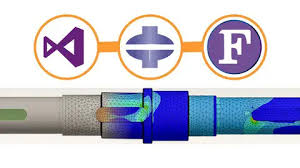
Abaqus VUMAT subroutineA VUMAT subroutine in Abaqus is a user-defined material model. It allows you to define custom material behaviors that are not available in the standard Abaqus material models.

VUMAT stands for Vectorized User Material. It is a Fortran subroutine that is called by Abaqus at each integration point during a simulation.

a VUMAT subroutine allows you to implement your own constitutive model for the material behavior in Abaqus. This is useful when the standard material models do not adequately capture the material response you are interested in.

For example, to model damage and failure in materials like ceramics, metals, and composites, you typically need a VUMAT subroutine that implements a damage initiation criterion and damage evolution law.

Elements

The model is supported for plane strain, axisymmetric, and 3D solid elements and can be used in both Lagrangian and Eulerian domains.

Drucker-Prager material model

The Drucker-Prager material model is a type of elastic-plastic material model used to model the yield and plastic behavior of soils and granular materials like sand, gravel, and rocks.

Additional information
Software

Abaqus FEA

Type

Abaqus tutorial course

Level

Advanced

Files

Abaqus workshop files: *.cae, *.jnl, *.inp, *.odb
Abaqus tutorial Video: *.mp4
Lecture notes: *.pdf
VUMAT subroutine file: *.for

Language

English

Category

Failure & damage analysis
High velocity impact analysis

Solver

Explicit

Material

Brittle materials
Ceramics
Concretes

Reviews (0)

Reviews

There are no reviews yet.

Be the first to review “Abaqus VUMAT JHB and JH-2 Ceramic Model” Cancel reply

You must be logged in to post a review.

Payment & Support

Satisfaction Guarantee & Instant Access

All products available on the BanuMusa R&D website come with a guarantee of customer satisfaction. You will receive an automated download link immediately after your purchase is processed. We also provide online consulting and mentoring to ensure you get the absolute most out of our engineering products.

Before buying, you can consult with our technical experts to ensure the product perfectly aligns with your project requirements.

Secure Payment Methods

Cryptocurrency (Fastest)

The easiest way to pay is through the Tether portal in our shop using your wallet. The download link will be generated automatically.

  • Tether (USDT) - TRC20
  • Tron (TRX)
Video Tutorials:
  • How to pay using USDT TRC-20
  • Tron TRC20 Wallet Tutorial

International e-Wallets

We support major digital wallets. Once your manual payment is verified, we will email you the download links.

  • Payoneer: Contact us to receive the payment address.
  • PayPal: Contact us for our official account.
  • PAYEER: Contact us for instructions.
  • WebMoney: Contact us for our WMZ wallet address.

Bank Transfer (SWIFT)

For corporate clients or large engineering software orders, we accept direct wire transfers.

Please contact our support team to receive our official SWIFT/IBAN banking details and a Proforma Invoice.

Need Help with Payment? Contact Us

If you cannot use the direct Tether gateway or need our payment details (PayPal, Payoneer, SWIFT, etc.), simply send us the product link via email or our social networks.

  • +98-915-5520-388 (WhatsApp, Telegram, WeChat)
  • info@banumusagr.com
  • +98-51-35424520
Content
  • Abaqus tutorial video (*.mp4)
  • Lecture notes (PDF)
  • Abaqus workshop files (*.cae, *.inp, *.jnl, *.odb)
  • JH-2 Fortran VUMAT subroutine run on Windows or Linux
  • 15-day money-back guarantee
  •   Free 24/7 online mentoring

Overview

  1. Introduction to VUMAT JHB & JH-2 ceramic model
  2. Abaqus VUMAT JHB & JH-2 ceramic model parameters
  3. Modeling ceramic failure with the JHB and JH-2 continuum damage mechanics models
  4. Implementing Johnson-Holmquist damage models for brittle ceramics in Abaqus
  5. Examples & workshops
  6. Additional modeling issues
  7. Limitations

You may also like…

-8%Hot
umat-vumat-subroutine-gtn-damage-model-abaqus GTN damage model Abaqus Shear-Modified GTN VUMAT Gurson-Tvergaard-Needleman plasticity ductile failure simulation void coalescence Abaqus
Compare
Close

VUMAT Subroutine: Shear Anisotropic Modified GTN Damage Model

€ 535.00 Original price was: € 535.00.€ 490.00Current price is: € 490.00.
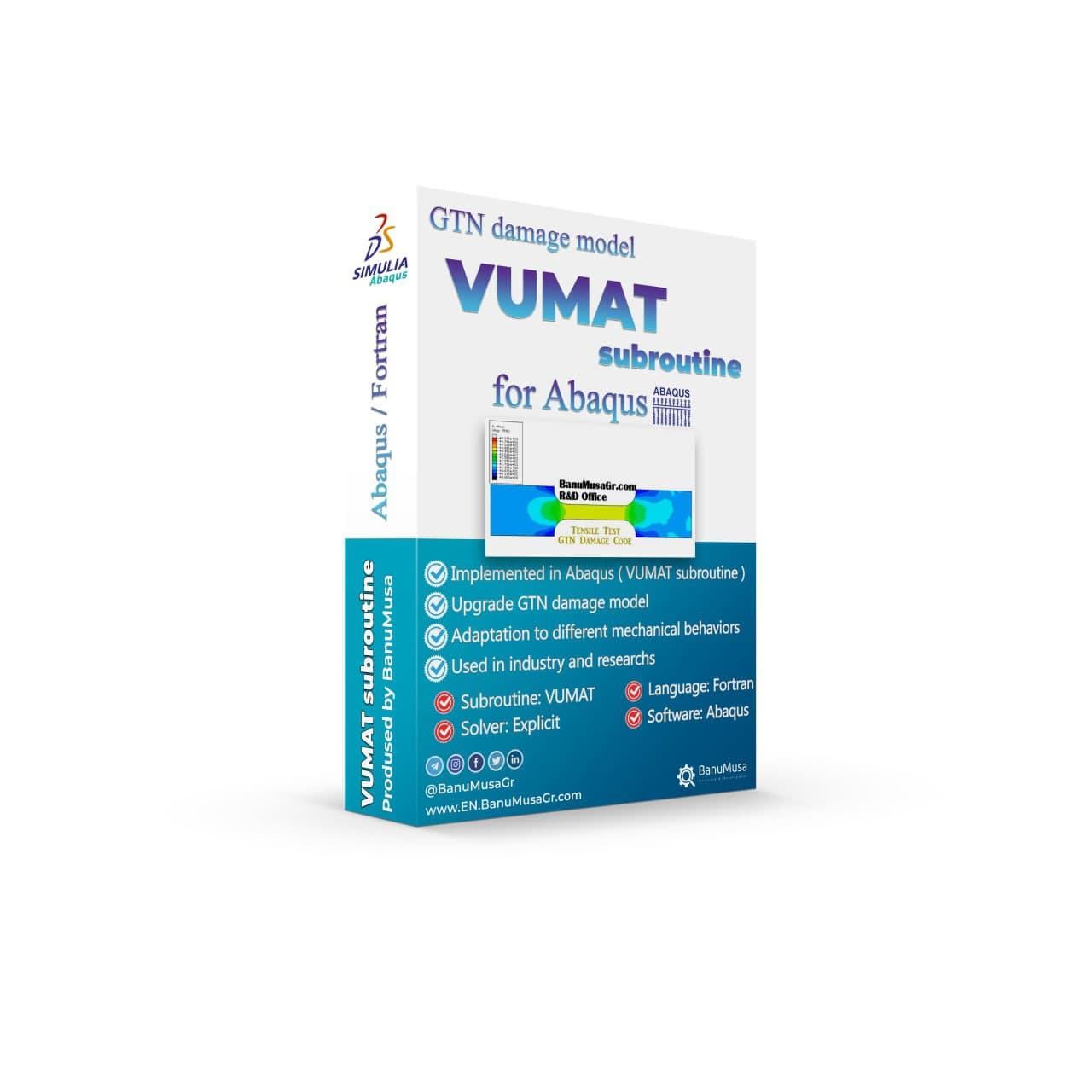
In this product, the modified GTN damage Abaqus VUMAT subroutine material model proposed by Gatea et al. (2017) was developed. In this material model, in addition to the original GTN model, the effects of plastic anisotropy and shear loading conditions have been added to increase the accuracy of solving the original GTN damage model. Also, the results have been verified and validated (V&V) with valid papers, and at the end, the extended damage model is compared with the Abaqus built-in GTN model known as the porous metal plasticity model. Lecture notes (PDF) Abaqus workshop files (*.cae, *.inp, *.jnl, *.odb) Fortran Abaqus subroutines run on Windows or Linux GTN material data (*.xls) 15-day money-back guarantee   Free 24/7 online mentoring
Add to wishlist
Add to cart
Quick view
Fortran for Abaqus Subroutine - writing user subroutines udhard umat film uload
Compare
Close

Fortran for Abaqus Subroutine

€ 255.00
If you are familiar with user subroutines in Abaqus, you must know that Fortran, C, and C# are languages that can be used to write subroutines in Abaqus. What is common among Abaqus users now is using Fortran in writing user subroutines. In the "Fortran for Abaqus Subroutine" training package, zero-to-one writing user subroutine tips are taught using Fortran in Abaqus. Abaqus tutorial video (*.mp4) Lecture notes (PDF) Abaqus workshop files (*.cae, *.inp, *.jnl, *.odb) Fortran Abaqus subroutines run on Windows or Linux 15-day money-back guarantee   Free 24/7 online mentoring
Add to wishlist
Add to cart
Quick view
-10%
larc05-abaqus-failure-criteria-composite-analysis
damage-larc05-abaqus4
Compare
Close

Abaqus Tutorial: LaRC05 Failure Criterion For Fiber-Reinforced Composites

Rated 5.00 out of 5
€ 110.00 Original price was: € 110.00.€ 99.00Current price is: € 99.00.
This comprehensive course provides a thorough understanding of the LaRC05 failure criterion for fiber-reinforced composites. Participants will delve into the theory behind the LaRC05 criterion and its significance in predicting failure behavior in these materials. Through practical implementation using the Abaqus software, students will learn how to characterize material properties, validate and verify simulations, and apply the LaRC05 criterion to solve real-world engineering problems. By the end of the course, participants will have gained the knowledge and skills necessary to confidently utilize the LaRC05 failure criterion for accurate analysis and design of fiber-reinforced composites. Abaqus tutorial video (*.mp4) Lecture notes (PDF) Abaqus workshop files (*.cae, *.inp, *.jnl, *.odb) 15-day money-back guarantee   Free 24/7 online mentoring
Add to wishlist
Add to cart
Quick view
Hot
abaqus explicit - 3d hashin
Compare
Close

3D Hashin VUMAT Subroutine for Abaqus with Exponential Damage Evolution

Rated 5.00 out of 5
€ 455.00
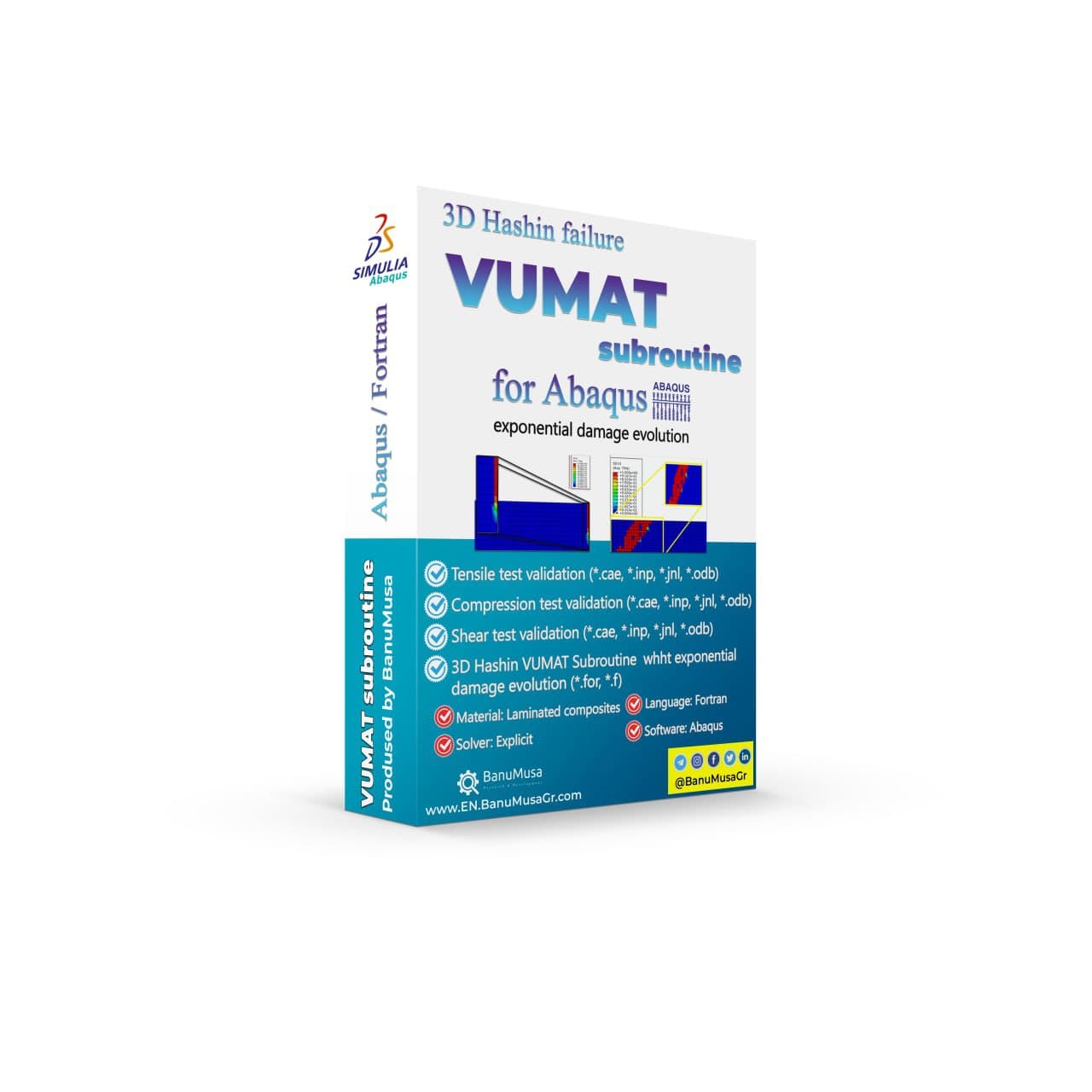
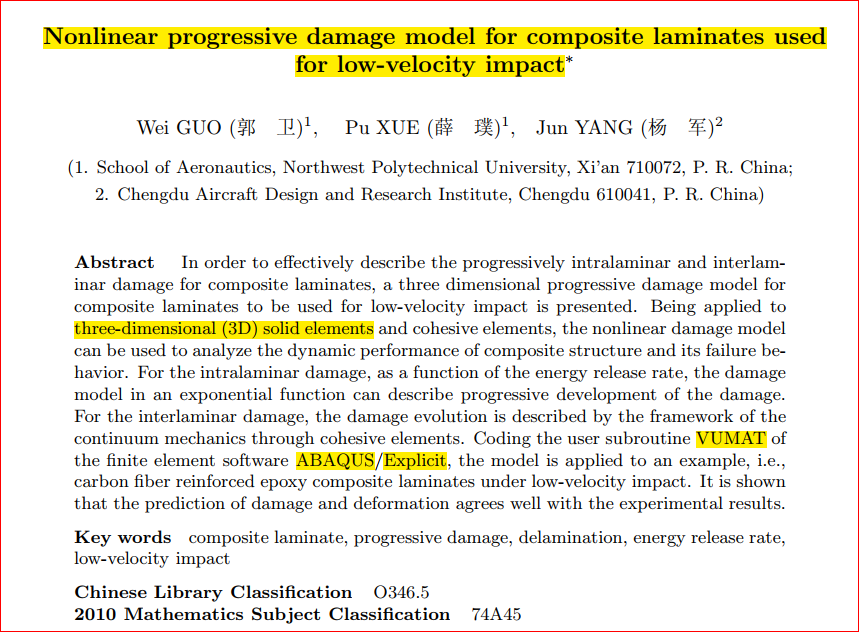
BanuMusa R&D presents a 3D Hashin VUMAT Subroutine for Abaqus with Exponential Damage Evolution. Effectively describe progressive intralaminar and interlaminar damage for FRP composite laminates using this three-dimensional progressive damage model based on continuum damage mechanics (CDM). Analyze dynamic performance and failure behavior of composite structures with this nonlinear damage model. Validated by well-known papers, this VUMAT subroutine can be used in any simulation. User manual (PDF) Abaqus workshop/validation files (*.cae, *.inp, *.jnl, *.odb) Fortran Abaqus subroutines run on Windows or Linux 15-day money-back guarantee   Free 24/7 online mentoring
Add to wishlist
Add to cart
Quick view

Related products

-4%
USDFLD Subroutine 3D Hashin
Compare
Close

3D Hashin USDFLD Subroutine Failure Criteria for Abaqus

€ 124.00 Original price was: € 124.00.€ 119.00Current price is: € 119.00.
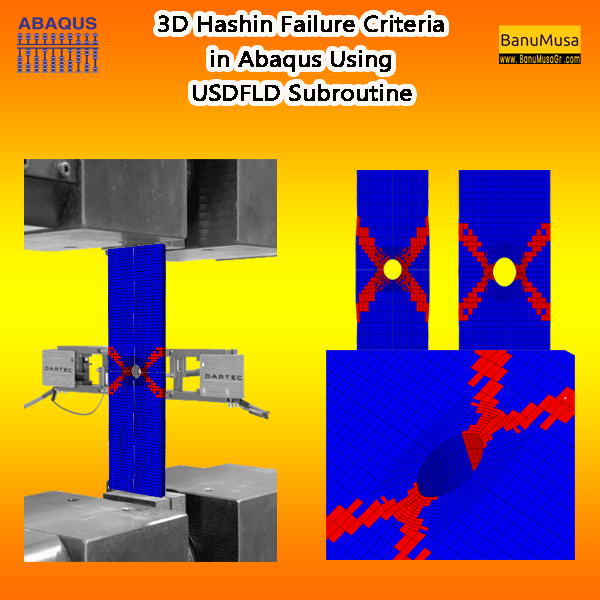
The 3D Hashin USDFLD subroutine is used in Abaqus to define failure criteria for composite materials based on the Hashin failure criteria and field variables (FV) for softening behavior. It allows you to specify the failure criteria for each ply of composite material in three dimensions (3D). This subroutine is particularly useful for analyzing the failure behavior of composite structures under various loading conditions in Abaqus simulations. It is a functionally validated USDFLD subroutine that compares results with the Chang & Lessard failure criterion available in Abaqus documentation. This code identifies four damage modes including matrix tension, matrix compression, fiber tension, and fiber compression using the elastic constants. Abaqus tutorial video (*.mp4) Lecture notes (PDF) Abaqus workshop files (*.cae, *.inp, *.jnl, *.odb) Fortran Abaqus subroutines run on Windows or Linux 15-day money-back guarantee   Free 24/7 online mentoring
Add to wishlist
Add to cart
Quick view
Hot
abaqus material library
Compare
Close

MatLib: The Ultimate Abaqus Material Library Plugin

Rated 4.75 out of 5
€ 315.00
Stop wasting hours on manual material calibration and unit conversions. MatLib is the ultimate Abaqus Material Library plugin, designed to accelerate your FEA simulations.

✅ 1,400+ Validated Materials (Metals, Polymers, Composites, etc.) ✅ 32 Engineering Categories ✅ 3 Consistent Unit Systems (SI-m, SI-mm, English/lb)

🎓 Student or Researcher? Apply for our 40% Academic Discount!

Add to wishlist
Add to cart
Quick view
Additive Manufacturing Simulation with Abaqus
Compare
Close

Additive Manufacturing Simulation with Abaqus

€ 410.00
Throughout Additive Manufacturing Simulation with Abaqus course, you will gain a deep understanding of the principles and techniques involved in additive manufacturing simulation using Abaqus software. You will learn how to simulate the complex processes involved in additive manufacturing, such as material deposition, thermal management, and residual stress analysis. By the end of the course, you will be equipped with the knowledge and skills to effectively utilize Abaqus for additive manufacturing simulation, making you a valuable asset in the field of advanced manufacturing. Abaqus tutorial video (*.mp4) Lecture notes (PDF) Abaqus workshop files (*.cae, *.inp, *.jnl, *.odb) 15-day money-back guarantee   Free 24/7 online mentoring
Add to wishlist
Add to cart
Quick view
-9%
Advanced Failure Analysis of Composite Materials Abaqus -helius
Compare
Close

Advanced Failure Analysis of Composite Materials with Abaqus and Autodesk Helius PFA: A Comprehensive Guide

€ 550.00 Original price was: € 550.00.€ 499.00Current price is: € 499.00.
The "Advanced Failure Analysis of Composite Materials with Abaqus and Autodesk Helius PFA: A Comprehensive Guide" online course is designed to teach engineers, technicians, and researchers advanced analysis techniques for composite materials. The course covers a range of topics, including material modeling, failure criteria, damage mechanics, progressive failure analysis of composites, and fatigue. Participants will learn how to use Abaqus and Autodesk Helius PFA software to model, simulate, and analyze composite materials under different loading conditions. The course is divided into several modules, each covering a different aspect of composite material analysis. The course provides an excellent opportunity for engineers and researchers to expand their knowledge of advanced analysis techniques for composite materials and gain hands-on experience with industry-standard software tools. Abaqus tutorial video (*.mp4) Lecture notes (PDF) Abaqus workshop files (*.k, d3plot) 15-day money-back guarantee   Free 24/7 online mentoring
Add to wishlist
Add to cart
Quick view
Introduction to VUMAT Subroutine Abaqus Mentoring Abaqus tutorial video
Introduction to VUMAT Subroutine Abaqus Mentoring- tutorial
Compare
Close

Introduction to VUMAT Subroutine

€ 210.00
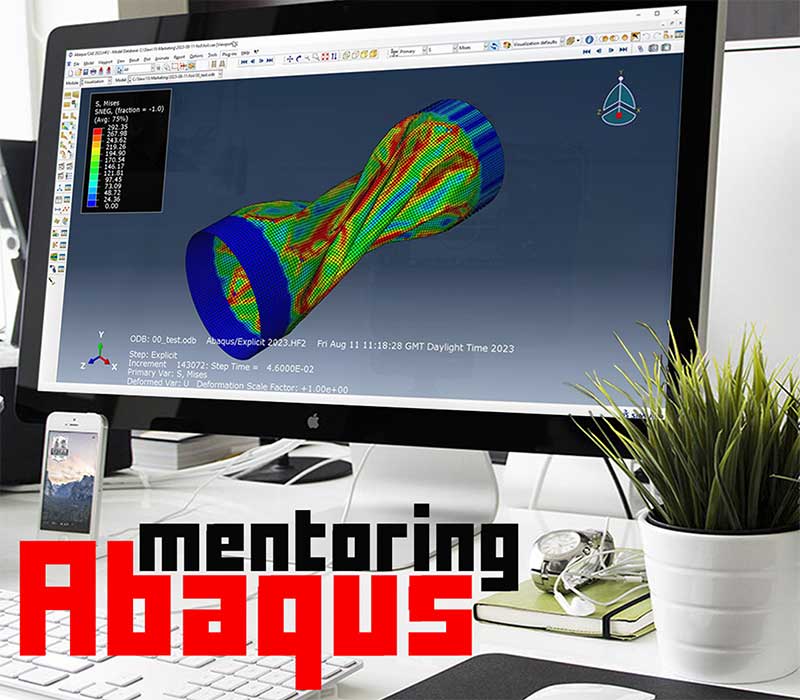
Introduction to VUMAT Subroutine course helps you to learn the process of writing VUMAT as quickly as possible with the help of practical examples. All the tips and details that you encounter to write the code are taught in this course and you can implement the material model in the subroutine. Because you may have questions while watching the course, an expert will answer your questions online. Abaqus tutorial video (*.mp4) Lecture notes (PDF) Abaqus workshop files (*.cae, *.inp, *.jnl, *.odb) Fortran subroutines 15-day money-back guarantee   Free 24/7 online mentoring
Add to wishlist
Add to cart
Quick view
Wound Composite Modeler Plugin for Abaqus
Compare
Close

Wound Composite Modeler Plugin for Abaqus

Rated 5.00 out of 5
€ 210.00
Engineering experts at SIMULIA have developed the Wound Composite Modeler plugin for Abaqus FEA software that enables the modeling of spatial variation of fiber orientation in a practical way. Because of the development of the use of composite materials and its widespread use in the manufacturing of pressure vessels by the filament winding method, the complexity of the design and analysis of these vessels prompted engineers to develop a tool for this purpose to increase the speed and accuracy of the design. Now, the WCM plugin (Ver. 2016) with extensive features is available. Documentation (PDF + HTML) Abaqus plugin files (*.RAR) Abaqus workshop files 15-day money-back guarantee   Free 24/7 online mentoring
Add to wishlist
Add to cart
Quick view
Porous Elastomers Abaqus UHYPER Subroutine
Compare
Close

Porous Elastomers Abaqus UHYPER Subroutine

€ 55.00
The " Porous Elastomers Abaqus UHYPER Subroutine " product implements the hyperelastic energy density derived for the macroscopic elastic response of non-Gaussian elastomers weakened by an isotropic and non-percolative distribution of equiaxed pores. This result is valid for any choice of I1-based incompressible energy density characterizing the non-Gaussian isotropic elastic response of the underlying elastomer. Lecture notes (PDF)   5 Abaqus example files (cae, inp, jnl, odb) FORTRAN UHYPER subroutine run on Windows or Linux 15-day money-back guarantee Free 24/7 online mentoring
Add to wishlist
Add to cart
Quick view
Step-By-Step Ansys Fluent Non Dimensional Laminar Flow Simulation Guide
Compare
Close

Step-By-Step Ansys Fluent Non Dimensional Laminar Flow Simulation Guide

€ 55.00
Step-By-Step Ansys Fluent Non Dimensional Laminar Flow Simulation Guide, will provide a detailed, step-by-step guide for performing non dimensional laminar flow simulations in Ansys Fluent. It covers all the necessary steps to set up and solve the model, as well as analyze and interpret the results.   Tutorial video (*.mp4)  Ansys Fluent files (in ANSYS workbench) Fluent lecture notes (*.pdf) 15-day money-back guarantee   Free 24/7 online mentoring
Add to wishlist
Add to cart
Quick view

BanuMusa R&D Simulation Consultancy

Bridging the gap between theoretical engineering and manufacturing reality. We provide high-fidelity FEA, CFD, and specialized Abaqus plugins to eliminate trial-and-error in critical industrial sectors.

Capabilities

  • FEA Consultancy
  • CFD Simulation
  • API 579 FFS Assessment
  • ASME Design by Analysis
  • Composite & COPV

Flagship Utilities

  • MatLib Material Database
  • WCM Plugin (COPV)
  • 3D Hashin VUMAT
  • Autokeeler (Metal Forming)
  • Johnson-Cook Plugin

Support & Resources

  • 40% Academic Discount
  • 1-on-1 Abaqus Mentoring
  • Advanced CAE Courses
info@banumusagr.com
06-02 Park View condo, Changkat perak, off Lorong Perak, 50250, Kuala Lumpur, Selangor, Malaysia
Accepted Payments
© 2026 BanuMusa R&D. Engineering Simulation & Automation. All rights reserved.
Support & FAQ Payment Methods Privacy Policy Terms of Service

Shopping cart

close

Powered by WhatsApp Chat

  • Menu
  • Categories
  • Consulting Services
  • Products
  • Resources
    • Blog
    • Projects
  • About Us
    • Contact Us
    • Our Team
    • Our Partners
    • Careers
  • Consulting Services
  • Products
  • Resources
    • Blog
    • Projects
  • About Us
    • Contact Us
    • Our Team
    • Our Partners
    • Careers

Sign in

close


Lost your password?
No account yet? Create an Account
Sidebar Scroll To Top