
 View Large
Fatigue and Static Damage in Chopped Composite Sheets
Project Overview: The Challenge of Chopped Fabric Composites
The industrial shift toward lightweight manufacturing has significantly increased the use of chopped fabric and randomly oriented fiber composites. These materials offer excellent formability for complex geometries and lower manufacturing costs compared to continuous fiber laminates. However, predicting their structural integrity under cyclic and static loading presents a massive challenge for design engineers.
While continuous fiber-reinforced polymers (FRP) benefit from well-established progressive failure criteria (such as Hashin or Puck), chopped composite sheets (also known as randomly oriented or needle-punched composites) present a highly complex engineering challenge. Because the fibers are randomly distributed, the material behaves quasi-isotropically on a macro scale but exhibits severe localized anisotropic damage mechanisms on a micro scale.
Standard built-in finite element material models often fail to accurately predict the mechanical degradation of these materials under severe loading. To address this limitation, the BanuMusa R&D engineering team initiated a specialized project to develop custom numerical damage models capable of tracking both static failure and cyclic fatigue degradation in chopped composite structures.
Project Methodology: Advanced Damage Modeling in Abaqus
After critically examining the advantages and disadvantages of various continuum damage mechanics (CDM) models for chopped fabric composites, our engineering team selected a highly specialized progressive damage model. The chosen model was optimized for computational applicability, ensuring rapid analysis times without sacrificing physical fidelity.
To implement this advanced theory into commercial FEA environments, standard Abaqus material models were insufficient. Therefore, our team transitioned to custom Fortran programming.

Custom Fortran Subroutine Development (VUSDFLD & VUMAT)
To implement this advanced mathematical model into the Abaqus solver, our R&D team programmed highly optimized user subroutines in Fortran. Depending on the solver requirements (Implicit vs. Explicit), two distinct sub-programs were developed:
-
VUSDFLD Subroutine: Developed to control field-variable-driven material degradation, allowing the solver to update mechanical properties at every integration point based on the current state of damage. (Also see our 3D Hashin USDFLD)
-
VUMAT Subroutine: A vectorized user material subroutine written for Abaqus/Explicit. This code explicitly defines the constitutive elasticity tensor, evaluates the damage initiation criteria, and governs the progressive damage evolution.
Capturing Sudden vs. Gradual Degradation
A critical achievement in this project was programming the subroutines to handle two distinct failure behaviors simultaneously:
-
Sudden Property Reduction: Simulating instantaneous fiber rupture or catastrophic matrix cracking where stiffness drops to near zero immediately.
-
Gradual Property Reduction: Modeling the gradual softening of the material due to accumulated micro-cracking and fiber-matrix debonding during cyclic fatigue.
(Are you interested in developing your own explicit damage models? Enroll in our comprehensive Introduction to VUMAT Subroutine Course.)
Loading Regimes: Static & Cyclic Analysis
The developed subroutines were rigorously tested and implemented for two distinct loading conditions, ensuring the model’s reliability for real-world industrial applications:
-
Predicting Static Damage: Simulating monotonic tensile, compressive, and shear loading to predict the ultimate strength, damage initiation point, and final rupture of the chopped composite sheets.
-
Predicting Fatigue Damage: Applying cyclic harmonic loading to evaluate the fatigue life. The subroutine actively tracks the gradual accumulation of damage, reducing the stiffness matrix over millions of cycles, ultimately generating highly accurate Stress-Life (S-N) curves for chopped fabric architectures.
Industrial Impact & Engineering Deliverables
By moving beyond the limitations of standard CAE software, BanuMusa R&D successfully delivered a fully functioning, computationally efficient numerical toolkit for chopped composites. This allows manufacturers in the automotive, aerospace, and consumer goods sectors to confidently transition from heavy metallic parts to lightweight chopped composite sheets, knowing that both static crashworthiness and long-term durability can be accurately simulated.
The subroutines were engineered with dual capabilities to handle the non-linear degradation of the chopped composite matrix:
-
Sudden Property Reduction: Simulating brittle failure modes where local stiffness drops to zero instantly upon reaching the critical failure threshold (e.g., fiber rupture).
-
Gradual Property Reduction: Utilizing cohesive damage evolution laws to simulate the progressive softening of the material (e.g., matrix micro-cracking and viscoelastic hysteresis).
This project was rigorously implemented and validated for two distinct industrial loading scenarios:
-
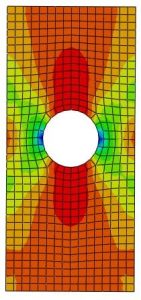
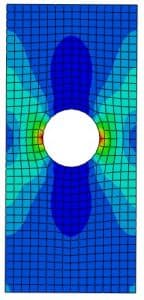
Predicting Static Damage in Chopped Composites: Evaluating the ultimate tensile/compressive strength, identifying the exact initiation of micro-cracks, and tracking the progressive failure path under monotonic loading.
-
Prediction of Fatigue Damage in Chopped Composites: Simulating cycle-by-cycle stiffness degradation. The model successfully tracked the cumulative damage under High-Cycle Fatigue (HCF), predicting the exact number of cycles before macroscopic structural failure.
(Note: For micro-scale fiber-matrix analysis, our team also utilizes the Micromechanics & Textile Homogenization Plugin to extract precise Representative Volume Element (RVE) properties.)
If your engineering firm requires advanced material modeling or custom subroutine development to bypass the limitations of commercial solvers, explore our Finite Element Analysis (FEA) Consultancy services.
Conclusion and Industrial Impact
By developing custom Fortran codes for Abaqus, BanuMusa R&D provided the client with a robust numerical toolkit capable of predicting the exact lifecycle of complex chopped composite parts. This predictive capability eliminates the need for endless, expensive physical fatigue testing, dramatically reducing the R&D timeline for new composite structures.
Fatigue in Complex Materials: Composites & Elastomers
Standard metal fatigue equations fail when applied to highly non-linear or anisotropic materials. BanuMusa R&D overcomes this limitation through advanced material calibration and proprietary code development:
-
Elastomer & Rubber Fatigue: Rubber components experience severe non-linearities and the Mullins effect under cyclic loading. We utilize hyperelastic constitutive models to predict the harmonic response and fatigue life of seals and bushings. 👉 Explore our industrial case study: Cyclic Analysis of Axial Flow Valve Sleeve.
-
Progressive Damage in Composites: Fatigue in Fiber-Reinforced Polymers (FRP) degrades through a complex sequence of matrix micro-cracking and fiber debonding. To accurately predict this, we go beyond the basic limits by using advanced progressive failure criteria.
-
3D Hashin Damage: We implement full 3D stress-state evaluation using our custom explicit codes. Check out our ready-to-use 3D Hashin VUMAT for Abaqus package to bypass the software’s 2D shell limitations.
-
LaRC05 Failure Criteria: For highly accurate predictions of matrix compression and fiber kinking, we use the LaRC05 criteria.
-
Developing Custom Fatigue Subroutines
Standard commercial solvers often lack the flexibility required for complex, non-proportional loading conditions. To evaluate complex real-time fatigue criteria, our R&D team develops proprietary user subroutines—such as UVARM for multiaxial fatigue evaluation and UMAT/VUMAT codes for tracking customized damage accumulation directly within the Abaqus solver.
Are you looking to implement your own material failure criteria, or do you need a pre-validated damage code? Browse our full library of advanced Abaqus User Subroutines.
Looking for Similar Engineering Results?
Don't let complex simulation challenges slow down your R&D. Our expert team at BanuMusa R&D is ready to provide tailored, highly accurate FEA and CFD solutions for your specific industry.
Request a Similar Simulation ProjectAccelerate Your Engineering Projects with BanuMusa R&D
Struggling with complex simulations, material calibration, or convergence issues? We provide professional solutions to guarantee your R&D success:
- 🚀 FEA & CFD Consultancy: Outsource your toughest structural, thermal, and fluid dynamics challenges to our industry experts.
- 🎓 Technical Abaqus Mentoring: Get 1-on-1 professional guidance to overcome specific modeling bottlenecks and save weeks of trial and error.
- 📚 Abaqus Material Library (MatLib): Skip manual mathematical calibration. Download hundreds of scientifically validated material models instantly.