
Optimizing Performance: FEA-Enhanced Medical Stent Design
The development of cardiovascular and peripheral stents represents a significant leap forward in interventional cardiology. However, designing a device that must be aggressively crimped, navigated through tortuous human arteries, expanded via balloon, and subjected to millions of systolic and diastolic pressure cycles presents a monumental engineering challenge.
Relying solely on physical prototyping and in-vivo testing for such complex medical devices is not only prohibitively expensive but also severely limits design optimization. At BanuMusa R&D, we transition this challenge into the digital domain. By integrating advanced Finite Element Analysis (FEA) techniques, our team has developed a groundbreaking approach to optimize stent structural integrity, biomechanical performance, and patient safety.
Our portfolio showcases our expertise in optimizing medical stents’ performance through Finite Element Analysis (FEA). FEA allows us to simulate and analyze the behavior of medical stents under various conditions, enabling us to enhance their design for better performance and durability.
The Material Challenge: Nitinol Superelasticity & Shape Memory
Modern medical stents are frequently manufactured from Nitinol, a nickel-titanium alloy renowned for its superelasticity and shape memory effect. Standard isotropic metal plasticity models completely fail to capture the complex Austenite-to-Martensite phase transformations that Nitinol undergoes during deformation.
To accurately represent this biomechanical behavior in Abaqus, BanuMusa R&D utilizes highly advanced UMAT and VUMAT user subroutines. These custom constitutive models allow our solvers to precisely track the phase transformation, latent heat release, and extreme stress-strain hysteresis of the stent during deployment.
(Are you an engineer struggling with Nitinol behavior? Explore Free Abaqus Plugin: Calibrate Nitinol Material & Superelastic Parameter Extraction.)
Looking for Similar Engineering Results?
Don't let complex simulation challenges slow down your R&D. Our expert team at BanuMusa R&D is ready to provide tailored, highly accurate FEA and CFD solutions for your specific industry.
Request a Similar Simulation ProjectFEA Simulation Workflow for Stent Deployment
Our comprehensive medical device simulation workflow captures the entire lifecycle of the stent, evaluating extreme non-linearities and complex contact mechanics:
1. Crimping and Navigation
Before deployment, the stent must be crimped onto a catheter delivery system. We simulate the large-deformation crimping process to ensure the stent structure does not suffer from premature plastic yielding or catastrophic buckling before it even reaches the target artery.
2. Balloon Expansion and Dogboning Effect
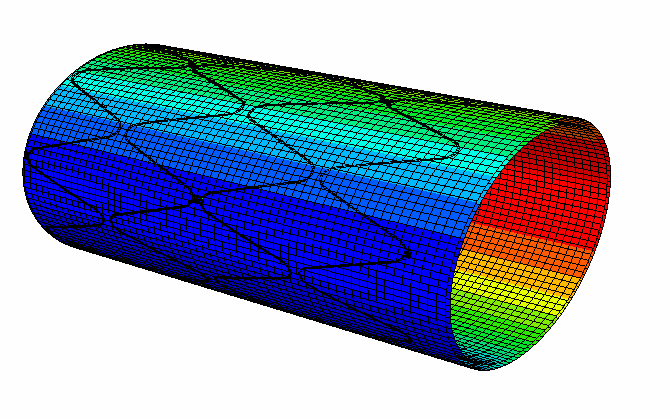
During deployment, the interaction between the inflating balloon, the stent struts, and the calcified arterial wall is highly dynamic. We utilize Abaqus/Explicit to model this complex fluid-structure and contact interaction. A critical output of this stage is predicting and minimizing the “Dogboning Effect”—where the ends of the stent over-expand compared to the middle, potentially injuring the vessel walls.
3. Elastic Recoil and Tissue Interaction
Once the balloon is deflated and removed, the stent undergoes elastic recoil. Our FEA models accurately predict the final resting diameter of the stent, ensuring sufficient radial outward force is maintained to keep the artery patent without causing excessive tissue hyperplasia.
Benefits of Using FEA for Medical Stent Evaluations
By applying strict Design by Analysis (DBA) methodologies, BanuMusa R&D helps medical device manufacturers achieve regulatory certification (such as FDA Class III approvals) significantly faster. The core benefits include:
-
Load History Mapping: Accurately representing the complete stress/strain history from manufacturing (annealing) to final in-vivo expansion.
-
Predicting Fatigue Life: Evaluating the implanted device’s response to pulsatile fatigue loading (High Cycle Fatigue over 10⁸ cycles) to ensure long-term durability.
-
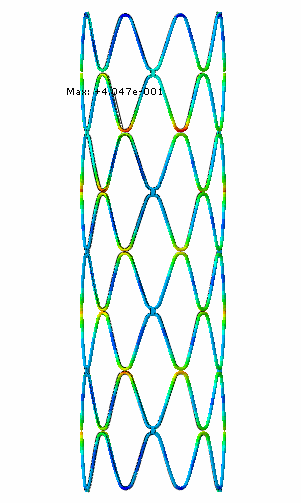
Safety Verification: Identifying precise locations of peak stress or strain concentrations that may adversely affect the structural integrity of the struts.
-
Vessel Interaction: Simulating the exact contact pressure between the device and the artery to minimize trauma during placement.
Accelerate Your Biomedical Engineering Projects
Whether you are designing self-expanding microdevices or balloon-expandable coronary stents, BanuMusa R&D provides the high-fidelity numerical insights required for clinical success.
For engineering teams looking to build their own internal capabilities, we offer a complete, ready-to-run industrial simulation package: 👉 Modeling Stents Using Abaqus (Complete Setup & Validation)
Accelerate Your Engineering Projects with BanuMusa R&D
Struggling with complex simulations, material calibration, or convergence issues? We provide professional solutions to guarantee your R&D success:
- 🚀 FEA & CFD Consultancy: Outsource your toughest structural, thermal, and fluid dynamics challenges to our industry experts.
- 🎓 Technical Abaqus Mentoring: Get 1-on-1 professional guidance to overcome specific modeling bottlenecks and save weeks of trial and error.
- 📚 Abaqus Material Library (MatLib): Skip manual mathematical calibration. Download hundreds of scientifically validated material models instantly.