

Advanced Materials and Manufacturing Processes Simulation
With the continuous growth of the global economy and the rapid transition toward Industry 4.0, the demand for high-precision materials and efficient, sustainable production processes has increased dramatically. Modern manufacturing requires producing complex, lightweight, and high-strength components with exceptionally tight tolerances. Whether in aerospace, automotive, or heavy machinery, industries are under constant pressure to reduce time-to-market, minimize material waste, and improve product lifecycles.
These advanced manufacturing processes require careful design, rigorous testing, and validation before physical implementation to avoid costly defects, tool breakage, and expensive trial-and-error loops. Today, advanced numerical simulations and Finite Element Analysis (FEA) serve as the backbone of the digital manufacturing revolution. As virtual testing environments, they are essential tools for predicting material behavior and optimizing industrial processes at the micro and macro levels. At Banu Musa R&D, we specialize in evaluating and simulating complex metal production methods—such as Rolling, Forging, Sheet Metal Forming, Casting, and Hydroforming—using robust engineering software like Abaqus and highly accurate material constitutive models.
Comprehensive Metal Forming Simulation
Metal forming is a critical area of mechanical engineering aimed at achieving desired component geometries through controlled plastic deformation. The permanent ductility of metals allows for the mass production of continuous profiles (wires, beams, pipes) and discrete structural components used in demanding industrial applications.
Understanding the highly non-linear material behavior during large deformations requires high-fidelity analysis. Materials subjected to forming undergo complex changes, including strain hardening, strain-rate dependency, and thermal softening. Using advanced computational methods, engineers can accurately predict critical parameters such as yield stress evolution, flow stress curves, and potential failure modes. This proactive approach ensures high dimensional accuracy, optimal mechanical properties, and the elimination of manufacturing bottlenecks.
Forging Process Analysis & Die Optimization
Forging is one of the oldest, most reliable, and structurally superior metal-forming methods. Because the process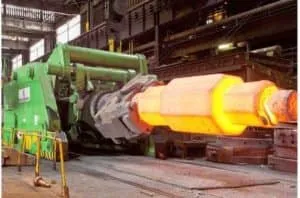 refines the grain structure and aligns it with the part’s geometry, forged components exhibit exceptional fatigue resistance and mechanical strength. The process involves shaping metal using localized compressive forces and can be executed as cold, warm, or hot forging (where the metal is heated above its recrystallization temperature).
In modern engineering, the design of closed-die or open-die forging processes is completely reliant on simulation. Accurate modeling of the friction between the workpiece and the die cavity is essential for predicting material flow and flash formation. Using robust finite element models, we help industries predict die wear cycles, optimize the required pressing force (tonnage), prevent internal defects (such as laps and folds), and manage thermal gradients during hot forging operations.
Casting & Solidification Modeling
Casting involves pouring liquid metal into a pre-designed mold cavity where it cools and solidifies into the final shape. It remains the most viable method for manufacturing massive or geometrically intricate parts, such as engine cylinder heads, turbine housings, and train wheels. However, the physical phenomena involved in casting are highly complex, often leading to challenges such as shrinkage porosity, hot tearing, residual stresses, and low dimensional accuracy.
By implementing precise thermomechanical and conjugate heat transfer simulations, we can evaluate melt flow behavior, cooling rates, and phase transformations during solidification. This enables the prediction of thermally induced residual stresses and potential structural failures before the physical mold is ever machined, drastically reducing prototyping costs.
Sheet Metal Working, Blanking & Formability
Sheet metal working encompasses a variety of techniques designed to transform flat metal sheets into functional 3D structures.
-
Shearing (Blanking and Punching): This is the process of cutting sheets between a sharp punch and a die. The desired cutout is known as a blank, while the remaining material is scrap. Simulating this requires advanced shear fracture modeling to predict edge quality and punch force.
-
Bending: Tilting the sheet around a linear axis to produce permanent deformation. A critical, persistent challenge in bending is spring back—the elastic recovery of the material caused by residual internal stresses after the punch is removed. FEA allows for exact spring back compensation in the die design phase.
-
Deep Drawing: Forming flat sheets into cup-shaped or hollow components (e.g., automotive body panels, kitchenware, and military ammunition shells) by pulling the metal into a die cavity.
To prevent manufacturing defects like wrinkling in the flange, tearing at the punch radius, and excessive springbuck, utilizing accurate material models (accounting for anisotropic yielding like Hill or Barlat) and robust damage criteria (such as GTN or Hashin models) in FEA software is crucial. We use these tools to generate precise Forming Limit Diagrams (FLD) and ensure safe process windows.
Looking for Similar Engineering Results?
Don't let complex simulation challenges slow down your R&D. Our expert team at BanuMusa R&D is ready to provide tailored, highly accurate FEA and CFD solutions for your specific industry.
Request a Similar Simulation ProjectRolling Process Multiphysics
Rolling is a highly efficient, continuous shaping process where plastic deformation occurs as the metal passes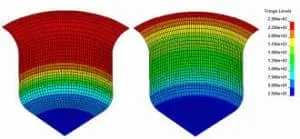 through one or multiple sets of heavy rollers. High production capacity makes this a cornerstone of the steel and aluminum industries. Rolling is generally categorized into:
-
Cold Rolling: Conducted at room temperature (up to 200°C), this process reduces sheet thickness while significantly increasing hardness, yield stress, and surface finish quality through strain hardening.
-
Hot Rolling: Performed above the recrystallization temperature (typically above 1100°C for steel), allowing for massive cross-sectional reductions without fracturing the material.
Our engineering capabilities include simulating various rolling configurations (longitudinal, transverse, screw, and cross-rolling). By building detailed contact mechanics models, we analyze the “friction hill,” calculate the required rolling torque and force, predict thickness reductions, and evaluate the residual stress distribution across the rolled profile.
High-Strain-Rate Explosive Forming
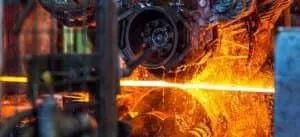
Explosive forming utilizes the extreme shock wave generated by an explosive detonation to shape metal parts. This high-energy-rate forming (HERF) method is particularly useful for manufacturing massive, thick-walled components—such as ship hulls, pressure vessel heads, and aerospace domes—where constructing mechanically equivalent hydraulic presses is economically unfeasible.
Typically, the explosive is submerged in a fluid medium (like water) above the sheet metal. The detonation creates a high-pressure shockwave that forces the sheet into the die cavity at extreme velocities. Simulating this dynamic, high-strain-rate process requires advanced explicit solvers (such as LS-DYNA or Abaqus/Explicit) to capture the fluid-structure interaction (FSI), acoustic wave propagation, and strain-rate-dependent plasticity (using equations like Johnson-Cook).
Advanced Hydroforming Simulation
Hydroforming utilizes high-pressure hydraulic fluid to shape raw materials against a female die, eliminating the need for a traditional mechanical punch. With the advancement of computerized controls and high-pressure fluid systems, hydroforming has become a standard for mass-producing complex, highly optimized, and lightweight components in the aerospace, petroleum, and automotive sectors.
-
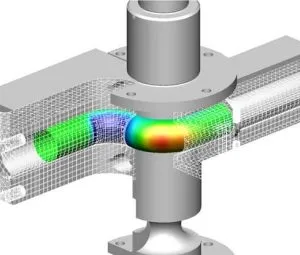 Sheet Hydroforming: Fluid pressure forces a flat metal sheet into a die cavity, offering better surface finishes and deeper draw ratios than conventional stamping.
 -
Tube Hydroforming: An empty tube is placed in a closed die. Internal fluid pressure, combined with simultaneous axial feeding (pushing the tube ends inward), expands the tube to its final complex cross-section.
The success of hydroforming heavily depends on controlling the loading path (the exact ratio of internal pressure vs. axial feed). Inappropriate selection of these parameters instantly leads to bursting (tearing) or buckling (wrinkling). Through comprehensive numerical simulation, we optimize the loading curves, determine the exact boundary conditions, and predict the final wall thickness distribution to ensure defect-free, mass-producible manufacturing.
Need Expert Assistance with Your Manufacturing Simulations? Whether you are dealing with complex material calibration, Fortran subroutine development, or large-deformation forming analysis, our team of simulation experts is ready to help bridge the gap between theoretical engineering and manufacturing reality. Explore our consulting services or utilize our advanced Abaqus plugins to eliminate trial-and-error and streamline your FEA workflows.
Accelerate Your Engineering Projects with BanuMusa R&D
Struggling with complex simulations, material calibration, or convergence issues? We provide professional solutions to guarantee your R&D success:
- 🚀 FEA & CFD Consultancy: Outsource your toughest structural, thermal, and fluid dynamics challenges to our industry experts.
- 🎓 Technical Abaqus Mentoring: Get 1-on-1 professional guidance to overcome specific modeling bottlenecks and save weeks of trial and error.
- 📚 Abaqus Material Library (MatLib): Skip manual mathematical calibration. Download hundreds of scientifically validated material models instantly.