


The Critical Role of Analytical Hand Calculations in Modern FEA Validation
The Misconception of the Modern CAE Engineer
It is a common scenario in the mechanical engineering industry: a junior analyst reviews a job description for a Finite Element Analysis (FEA) or Computer-Aided Engineering (CAE) role and spots “hand calculations” listed as a mandatory prerequisite. Often, this is misinterpreted as a nostalgic throwback to the pre-computational era. There is a lingering misconception that employers expect engineers to manually size complex aerospace or marine structures using a pencil and a notepad.
The reality of modern structural analysis is vastly different. In the context of advanced FEA, performing analytical hand calculations does not mean abandoning digital solvers. Instead, it signifies the foundational ability to evaluate and reason about a mechanical structure independently of the software. When a sophisticated solver like Abaqus, LS-DYNA, or Ansys outputs a stress contour, analytical methods are the very tools that empower an engineer to definitively state whether those results are physically accurate or merely numerical noise.
After years of developing, running, and debugging complex simulations—ranging from structural fatigue analysis to the highly non-linear material responses in sheet metal bending and punch-die mold assemblies—it becomes evident that the reliance on analytical fundamentals is the primary differentiator between a software operator and a true simulation engineer.
Why Analytical Methods Are Mandatory in Finite Element Analysis
The requirement for classical mechanics in CAE environments stems directly from rigorous engineering practices, quality assurance, and risk mitigation.
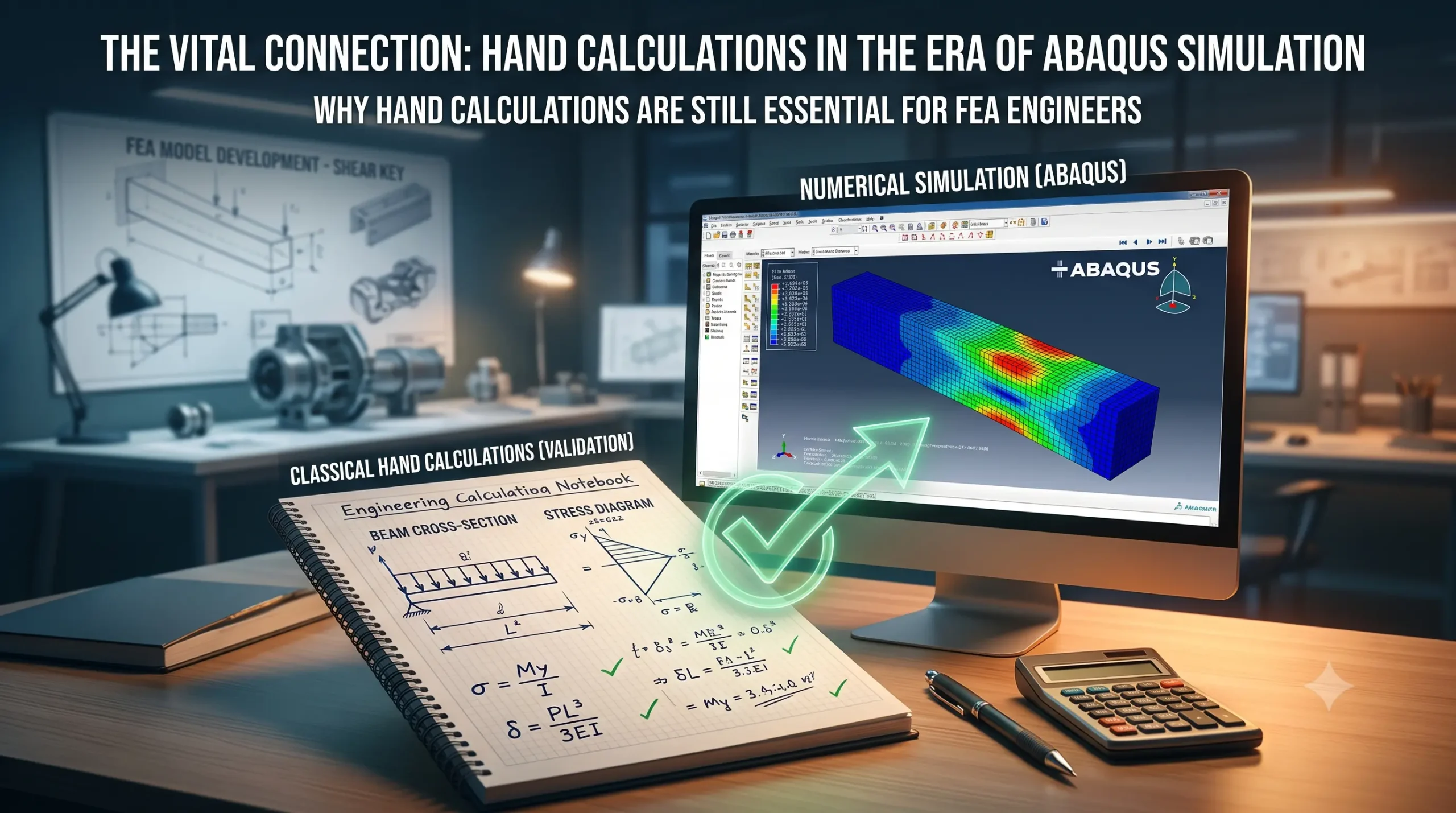 1. Verification of Numerical Results and Boundary Conditions
The foundational rule of numerical simulation is “Garbage In, Garbage Out.” A beautifully converged mesh will still produce entirely fabricated results if the boundary conditions or applied loads are incorrect. Analytical formulas—such as classical beam theory or Saint-Venant’s principle—allow engineers to establish an independent reference point. If the nominal stress derived from a quick analytical check differs from the FEA output by an order of magnitude, it immediately flags a fundamental error in the model setup. Discovering a constrained degree of freedom (DOF) error via a hand calculation saves immense computational time and project budget.
2. Preliminary Design and Feasibility Sizing
Before allocating computational resources to generate complex 3D meshes or configure non-linear material properties, an analytical pass dictates the viability of a design concept. Conducting fundamental calculations allows engineers to estimate critical thicknesses, define load paths, and shape the overall approach to the simulation. A complex structural model built upon the foundation of a preliminary analytical estimation is inherently more robust and computationally efficient.
3. Developing Structural Intuition for Debugging
Debugging a finite element model using only the finite element model is an exercise in futility. Working through the mechanics of a problem analytically builds a deep intuition regarding load transfer, stiffness matrices, and material behavior. For instance, when analyzing physical springback in a sheet metal forming process, understanding the theoretical elastic recovery of the material allows you to identify exactly why a simulation might be over-predicting the final radius. This fundamental insight is what you rely on when debugging highly non-linear contact or plasticity errors.
4. Regulatory Certification and Client Confidence
In high-stakes industries such as aerospace, marine architecture, and heavy machinery, regulatory bodies and classification societies strictly demand analytical justifications to accompany FEA reports. An analytical calculation offers complete transparency; the assumptions, load cases, and safety factors can be followed step-by-step. This transparency is heavily utilized to validate simulations against compliance standards, fostering absolute trust with stakeholders and clients.
The Essential Analytical Toolkit for Structural Analysts
The expectation is not that engineers memorize esoteric mathematical proofs, but rather that they possess absolute fluency in the classical structural mechanics toolkit. A competent FEA engineer should be able to instantly deploy the following principles:
-
Axial Load Formulations: Direct calculation of uniform stress, strain, and deformation.
-
Beam Bending Theories: Application of both Euler-Bernoulli (for slender beams) and Timoshenko theory (accounting for transverse shear deformation in thick beams).
-
Torsion and Shear: Calculating shear stresses in solid shafts and evaluating shear flow across thin-walled sections.
-
Pressure Vessel Mechanics: Determining hoop (circumferential) and longitudinal stresses in thin-walled and thick-walled cylinders.
-
Buckling Instability: Utilizing Euler’s critical load formulas for column buckling and understanding the limitations of linear eigenvalue buckling in FEA.
-
Fundamental Dynamics: Approximating the natural frequencies of single-degree-of-freedom (SDOF) systems for vibration analysis.
The true skill lies not in the complexity of the math, but in the rapid application of the appropriate theory, accompanied by a strict understanding of the underlying assumptions.
Strategic Methods to Master Analytical Validation
For engineers looking to bridge the gap between software proficiency and analytical mastery, deliberate practice is required.
Curate a Definitive Reference Library
Every simulation engineer should have immediate access to standard texts. Roark’s Formulas for Stress and Strain remains the absolute gold standard for closed-form analytical solutions. Texts like James Gere’s Mechanics of Materials provide the core foundational theory, while Shigley’s Mechanical Engineering Design is indispensable for specific machine components.
Benchmark Software Against Theory
The most effective way to learn is by intentional benchmarking. Model simplified geometries—such as pressure vessel shells, standard I-beams, or basic lug joints—using 1D beam elements and 2D shell elements in your preferred solver. Compare the numerical stress and displacement outputs directly against your manual calculations. Investigating the minor discrepancies between the two methods forces a deep comprehension of element formulations, integration points, and mesh convergence.
Document Assumptions and Simplifications
Analytical calculations are inherently built upon simplifications: isotropic linear elasticity, idealized constraints, and perfect geometry. Real-world FEA often incorporates non-linear plasticity, hyperelasticity, and complex friction models. A critical aspect of structural engineering is knowing precisely when the simplifying assumptions of hand calculations break down, and when advanced numerical methods must take over.
Engineering Integrity Beyond the Mesh
When a technical role demands proficiency in hand calculations, it is fundamentally a test of engineering integrity. It is an inquiry into whether an engineer can independently validate their findings, estimate mechanical behavior with authority, and articulate their technical justifications without hiding behind a colorful stress contour.
As computational power scales and CAE software becomes increasingly automated, the tools will continue to evolve. However, the engineers who will lead the industry are those who utilize the software to verify their engineering judgment, rather than relying on the software to formulate it for them.
Elevate Your FEA Expertise with BanuMusa
If you are looking to enhance your structural analysis capabilities or require expert guidance on complex simulation projects, BanuMusa R&D offers specialized consulting and mentoring services tailored for mechanical engineers. With deep, practical expertise in industry-leading solvers like Abaqus and Ansys, the BanuMusa engineering team provides comprehensive solutions ranging from advanced FEA model debugging to personalized training programs. Whether you need independent analytical validation of your numerical results, assistance with highly non-linear simulations, or hands-on mentoring to bridge the gap between classical theory and software application, BanuMusa is dedicated to empowering you to deliver robust, reliable, and highly accurate engineering designs.
Frequently Asked Questions (FAQ)
Q1: Why do modern engineering companies still require hand calculations for FEA roles? Employers require hand calculations to ensure that an analyst can independently verify software outputs and understand the underlying structural mechanics. A numerical solver will always output a result, even if the inputs are flawed. Hand calculations act as a critical sanity check to catch boundary condition errors, incorrect load applications, or unit mismatches before they lead to catastrophic and costly design failures. It proves the engineer understands the physics, not just the software interface.
Q2: Can analytical hand calculations completely replace Finite Element Analysis? No, they cannot. Hand calculations rely on mathematical idealizations, linear elastic assumptions, and simplified geometries. While they are perfect for preliminary design sizing and validating basic load paths, FEA is absolutely essential for analyzing complex 3D CAD geometries, non-linear material behaviors (such as hyperelasticity or plasticity), complex contact mechanics, and dynamic load cases where classical formulas break down. The two methods are meant to be complementary, not mutually exclusive.
Q3: What are the most effective resources for an FEA engineer to master these classical calculations? The most effective approach is a combination of theoretical study and practical benchmarking. Roark’s Formulas for Stress and Strain is the definitive industry standard for closed-form analytical solutions. For foundational mechanics, Mechanics of Materials by James Gere is highly recommended. To truly master the skill, engineers should practice by solving simple structural problems manually and immediately comparing their results with 1D beam or 2D shell simulations in Abaqus or Ansys to understand the variations.
Accelerate Your Engineering Projects with BanuMusa R&D
Struggling with complex simulations, material calibration, or convergence issues? We provide professional solutions to guarantee your R&D success:
- 🚀 FEA & CFD Consultancy: Outsource your toughest structural, thermal, and fluid dynamics challenges to our industry experts.
- 🎓 Technical Abaqus Mentoring: Get 1-on-1 professional guidance to overcome specific modeling bottlenecks and save weeks of trial and error.
- 📚 Abaqus Material Library (MatLib): Skip manual mathematical calibration. Download hundreds of scientifically validated material models instantly.