



Show
All
Additive Manufacturing Simulation with Abaqus
Throughout Additive Manufacturing Simulation with Abaqus course, you will gain a deep understanding of the principles and techniques involved in additive manufacturing simulation using Abaqus software. You will learn how to simulate the complex processes involved in additive manufacturing, such as material deposition, thermal management, and residual stress analysis. By the end of the course, you will be equipped with the knowledge and skills to effectively utilize Abaqus for additive manufacturing simulation, making you a valuable asset in the field of advanced manufacturing.
Abaqus tutorial video (*.mp4)
Lecture notes (PDF)
Abaqus workshop files (*.cae, *.inp, *.jnl, *.odb)
15-day money-back guarantee
Free 24/7 online mentoring
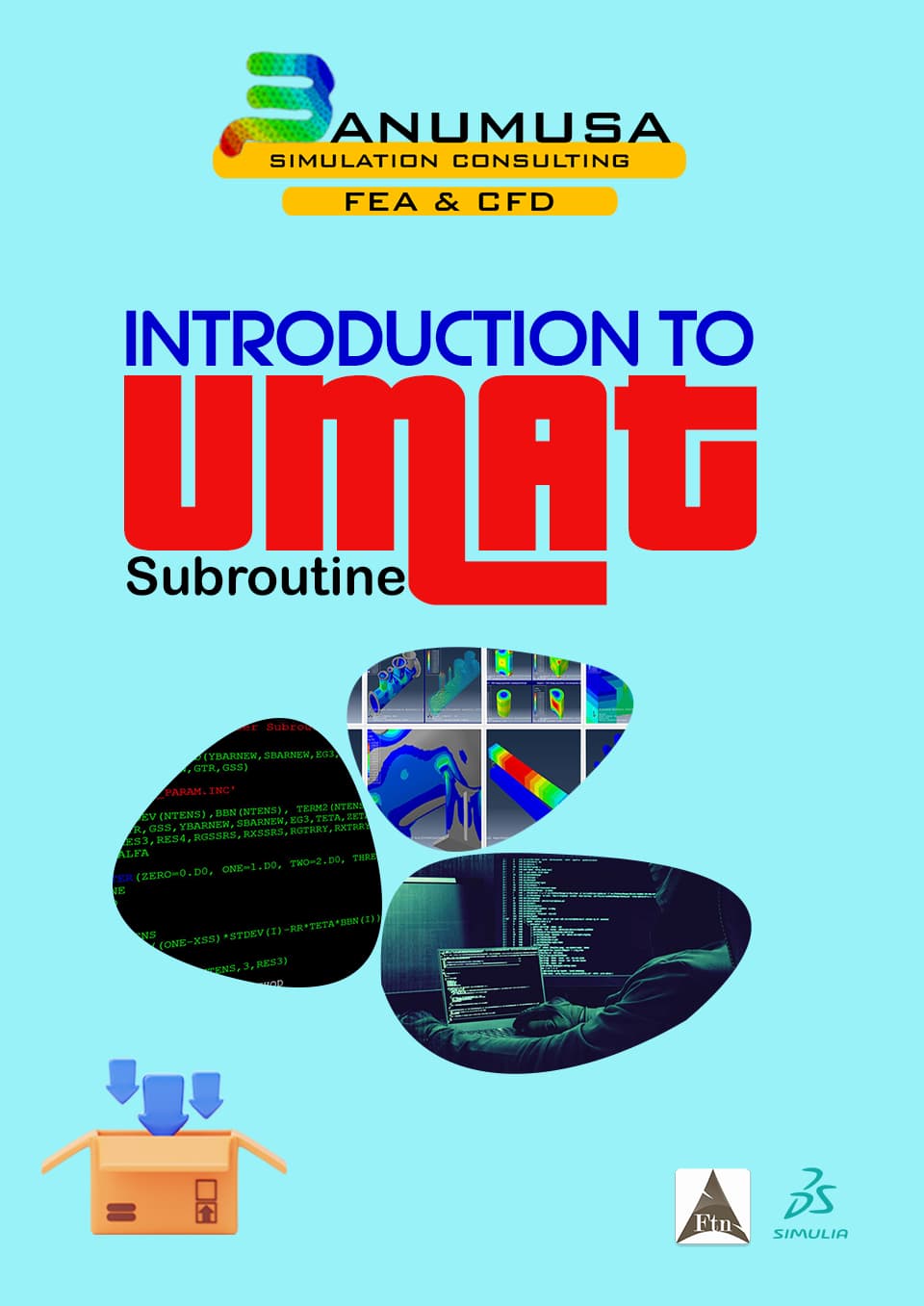
Introduction to UMAT Subroutine
Introduction to UMAT Subroutine course helps you to learn the process of writing UMAT as quickly as possible with the help of practical examples. All the tips and details that you encounter to write the code are taught in this course and you can implement the material model in the subroutine. Because you may have questions while watching the course, an expert will answer your questions online.
Abaqus tutorial video (*.mp4)
Lecture notes (PDF)
Abaqus workshop files (*.cae, *.inp, *.jnl, *.odb)
Fortran subroutines
15-day money-back guarantee
Free 24/7 online mentoring
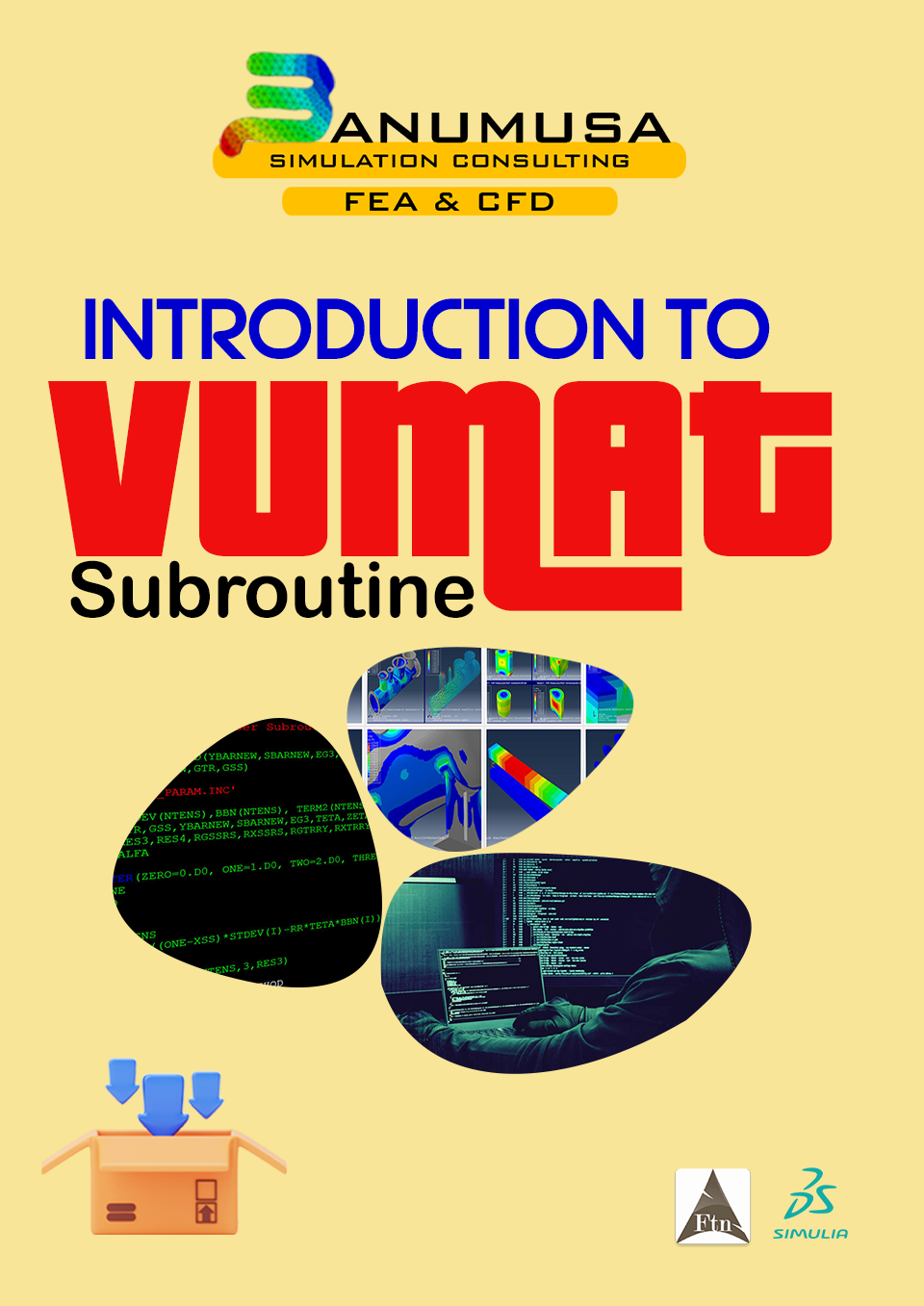
Introduction to VUMAT Subroutine
Introduction to VUMAT Subroutine course helps you to learn the process of writing VUMAT as quickly as possible with the help of practical examples. All the tips and details that you encounter to write the code are taught in this course and you can implement the material model in the subroutine. Because you may have questions while watching the course, an expert will answer your questions online.
Abaqus tutorial video (*.mp4)
Lecture notes (PDF)
Abaqus workshop files (*.cae, *.inp, *.jnl, *.odb)
Fortran subroutines
15-day money-back guarantee
Free 24/7 online mentoring
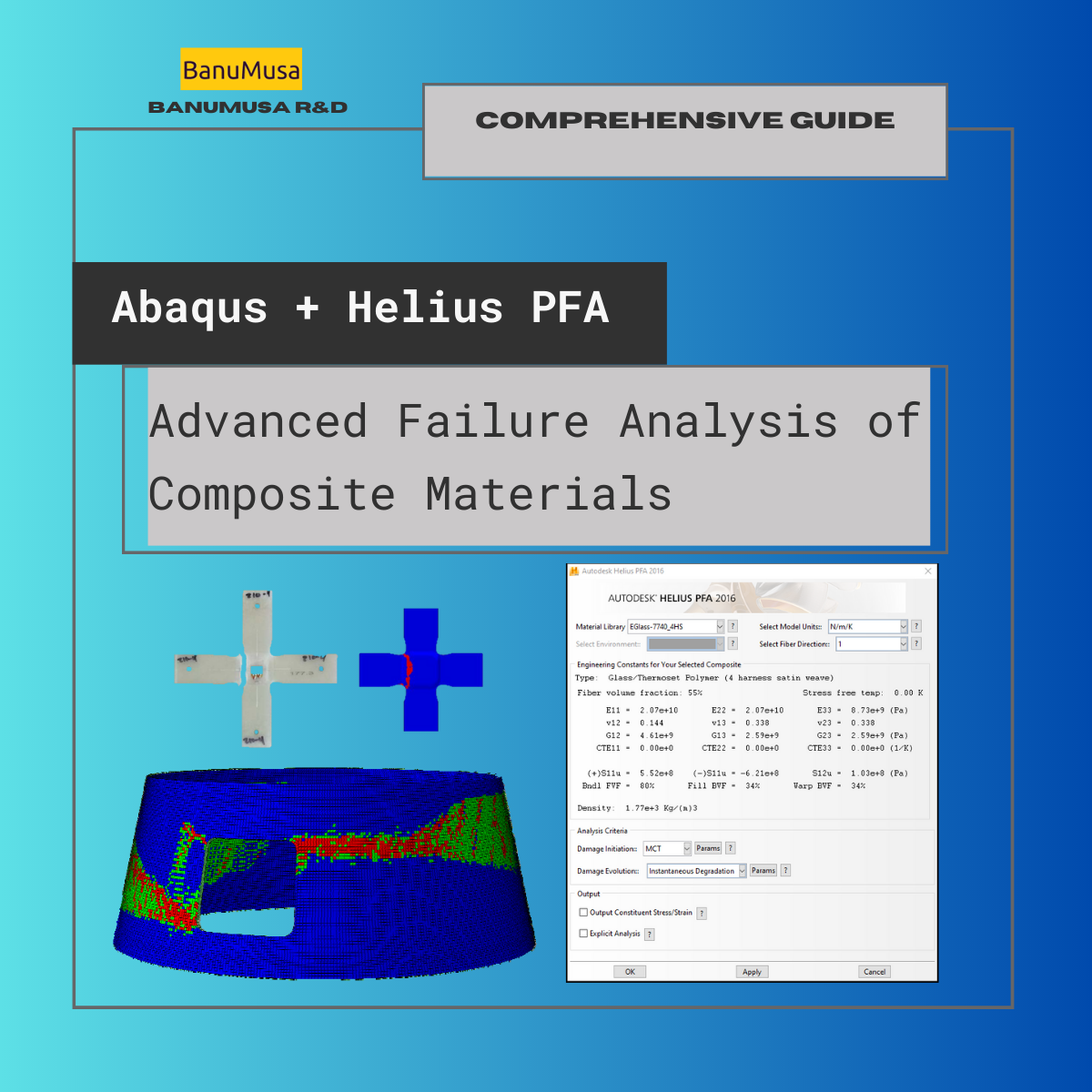
Advanced Failure Analysis of Composite Materials with Abaqus and Autodesk Helius PFA: A Comprehensive Guide
The "Advanced Failure Analysis of Composite Materials with Abaqus and Autodesk Helius PFA: A Comprehensive Guide" online course is designed to teach engineers, technicians, and researchers advanced analysis techniques for composite materials. The course covers a range of topics, including material modeling, failure criteria, damage mechanics, progressive failure analysis of composites, and fatigue.
Participants will learn how to use Abaqus and Autodesk Helius PFA software to model, simulate, and analyze composite materials under different loading conditions. The course is divided into several modules, each covering a different aspect of composite material analysis. The course provides an excellent opportunity for engineers and researchers to expand their knowledge of advanced analysis techniques for composite materials and gain hands-on experience with industry-standard software tools.
Abaqus tutorial video (*.mp4)
Lecture notes (PDF)
Abaqus workshop files (*.k, d3plot)
15-day money-back guarantee
Free 24/7 online mentoring
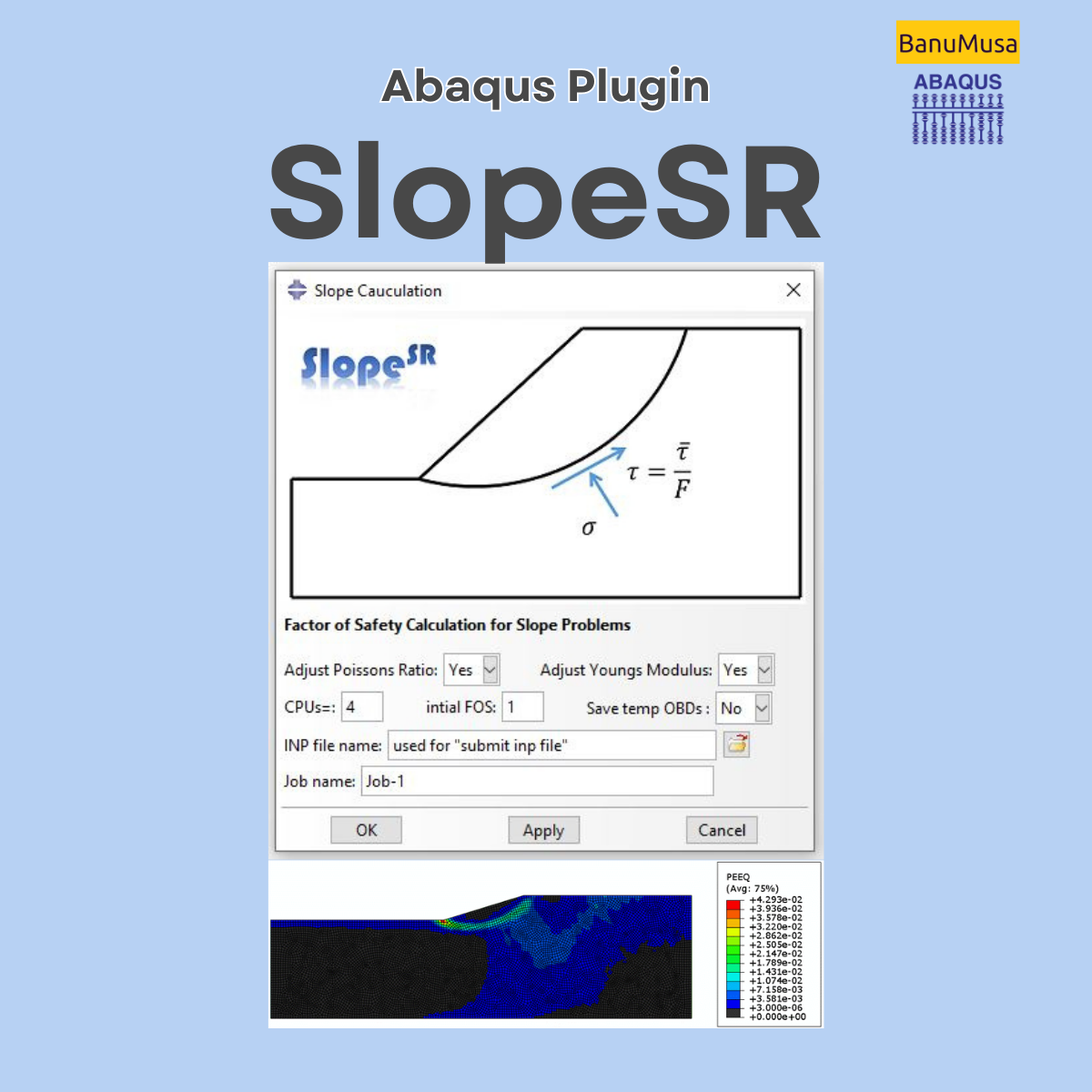
SlopeSR Plugin for Abaqus
The SlopeSR Plugin for Abaqus is a GUI plug-in that uses the strength reduction method (SRM) to calculate the factor of safety (FoS) and critical slip surfaces for 2D and 3D slopes. It is designed for slope stability analysis in geomechanics and geotechnical engineering. The plugin allows users to solve a series of elastic-perfectly plastic problems with the strength parameters and the Mohr-Coulomb criterion in ABAQUS/CAE.
Documentation (PDF )
Abaqus plugin files (*.RAR)
Abaqus workshop files
15-day money-back guarantee
Free 24/7 online mentoring
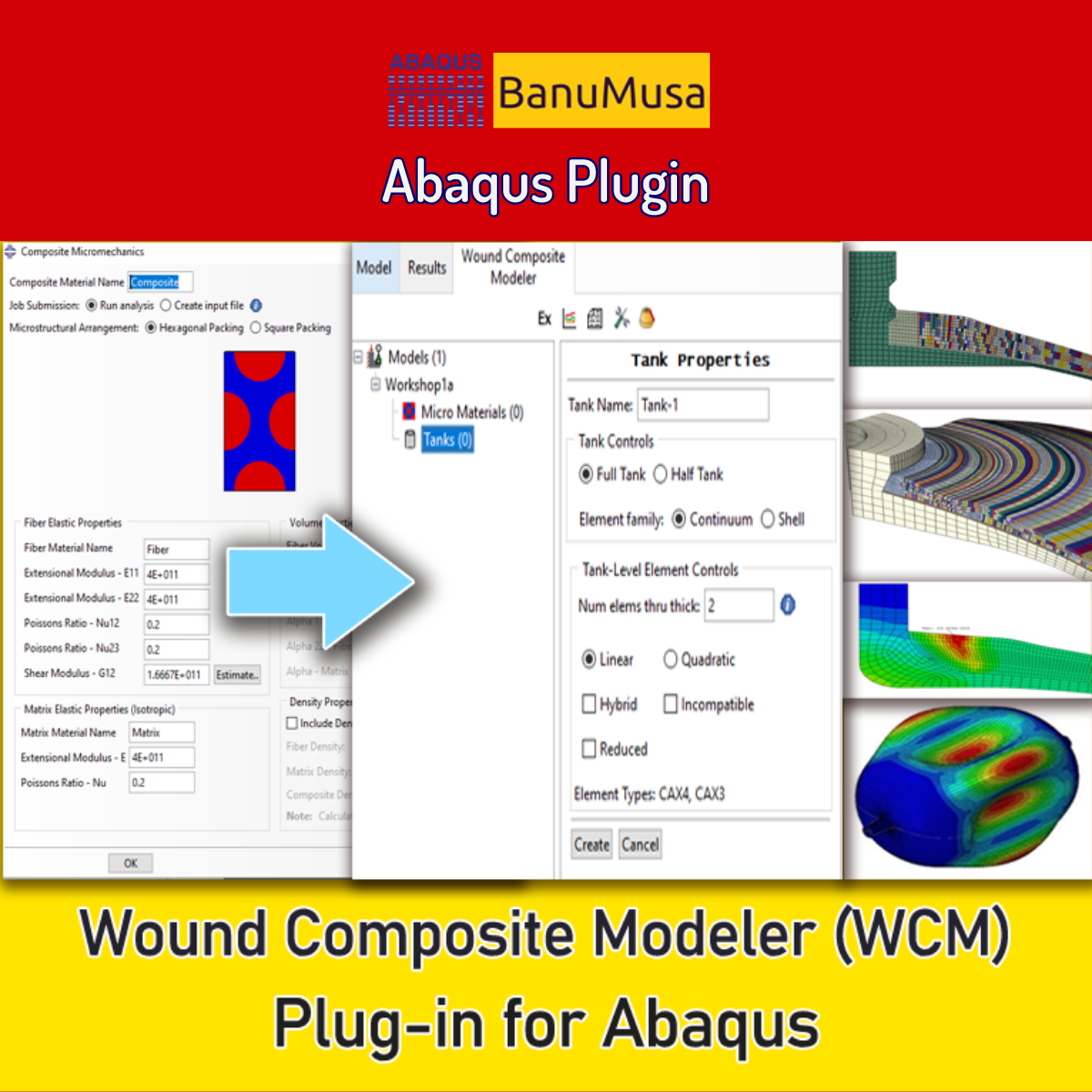
Wound Composite Modeler Plugin for Abaqus
Engineering experts at SIMULIA have developed the Wound Composite Modeler plugin for Abaqus FEA software that enables the modeling of spatial variation of fiber orientation in a practical way. Because of the development of the use of composite materials and its widespread use in the manufacturing of pressure vessels by the filament winding method, the complexity of the design and analysis of these vessels prompted engineers to develop a tool for this purpose to increase the speed and accuracy of the design. Now, the WCM plugin (Ver. 2016) with extensive features is available.
Documentation (PDF + HTML)
Abaqus plugin files (*.RAR)
Abaqus workshop files
15-day money-back guarantee
Free 24/7 online mentoring
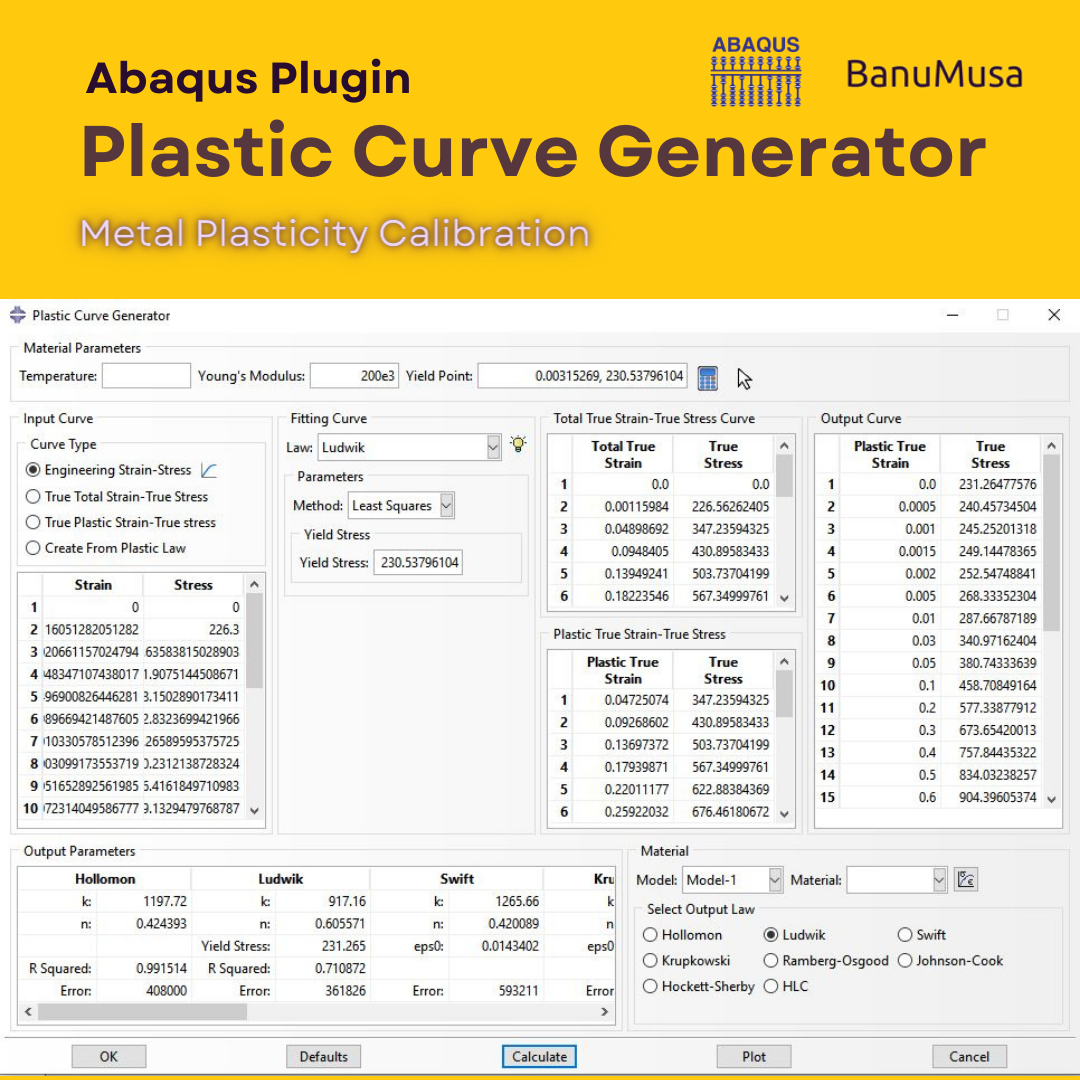
Plastic Curve Generator Plugin for Abaqus
The Plastic Curve Generator plugin helps the Abaqus user to create stress-strain curves easily. The input data can be either: engineering stress-strain curves, true total stress-strain curves, or true plastic strain-stress curves. It makes automatically all the conversions needed from the input data, giving the user the total true curve, plastic curve, and output curve, which is obtained according to the plastic flow laws.
Documentation (PDF + HTML)
Abaqus plugin files (*.RAR)
15-day money-back guarantee
Free 24/7 online mentoring
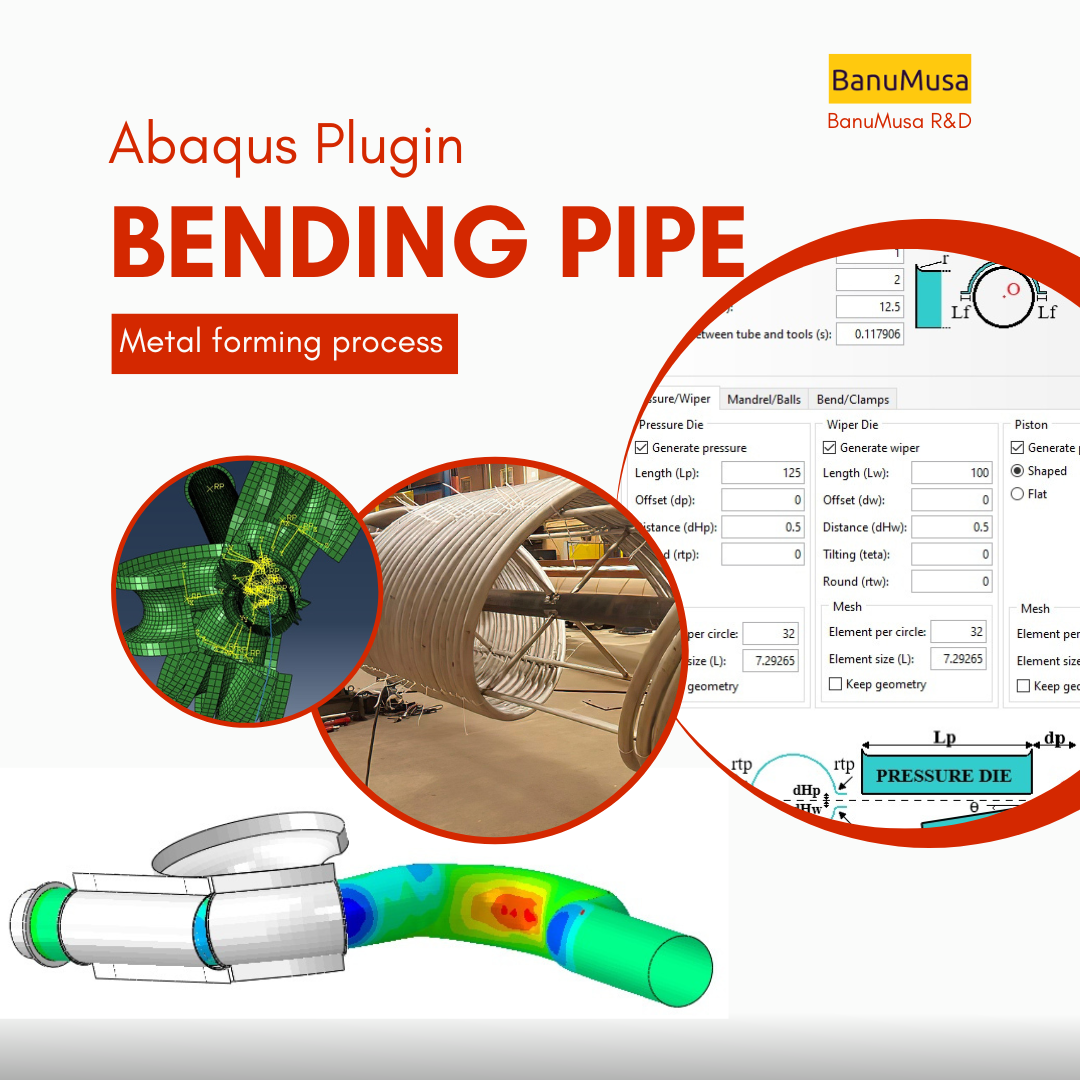
Bending Pipe Plugin for Abaqus
The Bending Pipe Plugin allows an Abaqus/CAE user to create and execute bending pipe analysis with little effort. Using a simple wizard approach, the plugin guides the user to define different bending methods. The methods included in the Abaqus plugin are: 1- Classical Bending, 2- Compression Bending, 3- Roll Bending, 4- Press Bending, 5- Stretch Bending, & 6- One Step (currently this option only creates both meshes undeformed and deformed)
Documentation (PDF + HTML)
Abaqus plugin files (*.RAR)
15-day money-back guarantee
Free 24/7 online mentoring
Fortran for Abaqus Subroutine
If you are familiar with user subroutines in Abaqus, you must know that Fortran, C, and C# are languages that can be used to write subroutines in Abaqus. What is common among Abaqus users now is using Fortran in writing user subroutines. In the "Fortran for Abaqus Subroutine" training package, zero-to-one writing user subroutine tips are taught using Fortran in Abaqus.
Abaqus tutorial video (*.mp4)
Lecture notes (PDF)
Abaqus workshop files (*.cae, *.inp, *.jnl, *.odb)
Fortran Abaqus subroutines run on Windows or Linux
15-day money-back guarantee
Free 24/7 online mentoring
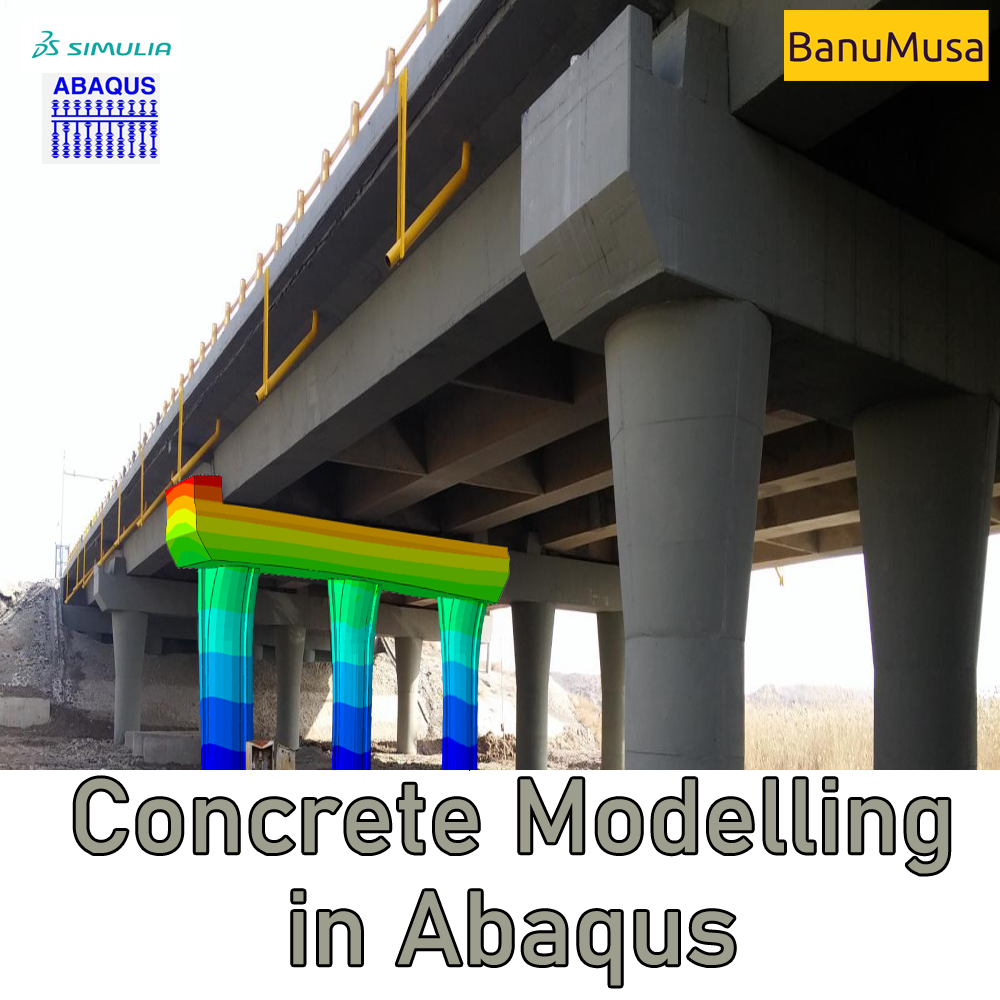
Mastering Concrete Modeling in Abaqus: A Comprehensive Course
In the "Concrete Modeling in Abaqus" tutorial video course, we have tried to cover all the tips and tricks the user requires when modeling concrete structures. Material models are available in the Abaqus and their parameters are described. Also, the modeling methods of rebars and reinforcements are expressed one by one and the strengths and weaknesses of each are examined. Finally, in 3 comprehensive examples in the field of explosion, fire, and connections, these cases are used in practice.
Abaqus tutorial video (*.mp4)
Lecture notes (PDF)
Abaqus workshop files (*.cae, *.inp, *.jnl, *.odb)
Concrete Damage Plasticity Calculator Tool (*.xls)
15-day money-back guarantee
Free 24/7 online mentoring
Abaqus VUMAT JHB and JH-2 Ceramic Model
In Abaqus VUMAT JHB and JH-2 Ceramic Model tutorial course, you will learn how to use Built-in VUMAT subroutines in Abaqus to predict brittle materials (e.g. ceramic materials) damage using Johnson, Holmquist, and Beissel (JHB) and Johnson-Holmquist (JH-2) ceramic model. Also, 5 practical workshops show you how to define and use the subroutine, how to configure the model in Abaqus CAE, and how to visualize the results. There is also a JH-2 VUMAT subroutine Fortran file in this CAE package. In addition to the tutorial video, the Abaqus workshop files, & JH-2 VUMAT subroutine will be provided to you so that nothing will remain unclear. Also, all course includes free online 24/7 online tutoring after purchase.
Abaqus tutorial video (*.mp4)
Lecture notes (PDF)
Abaqus workshop files (*.cae, *.inp, *.jnl, *.odb)
JH-2 Fortran VUMAT subroutine run on Windows or Linux
15-day money-back guarantee
Free 24/7 online mentoring
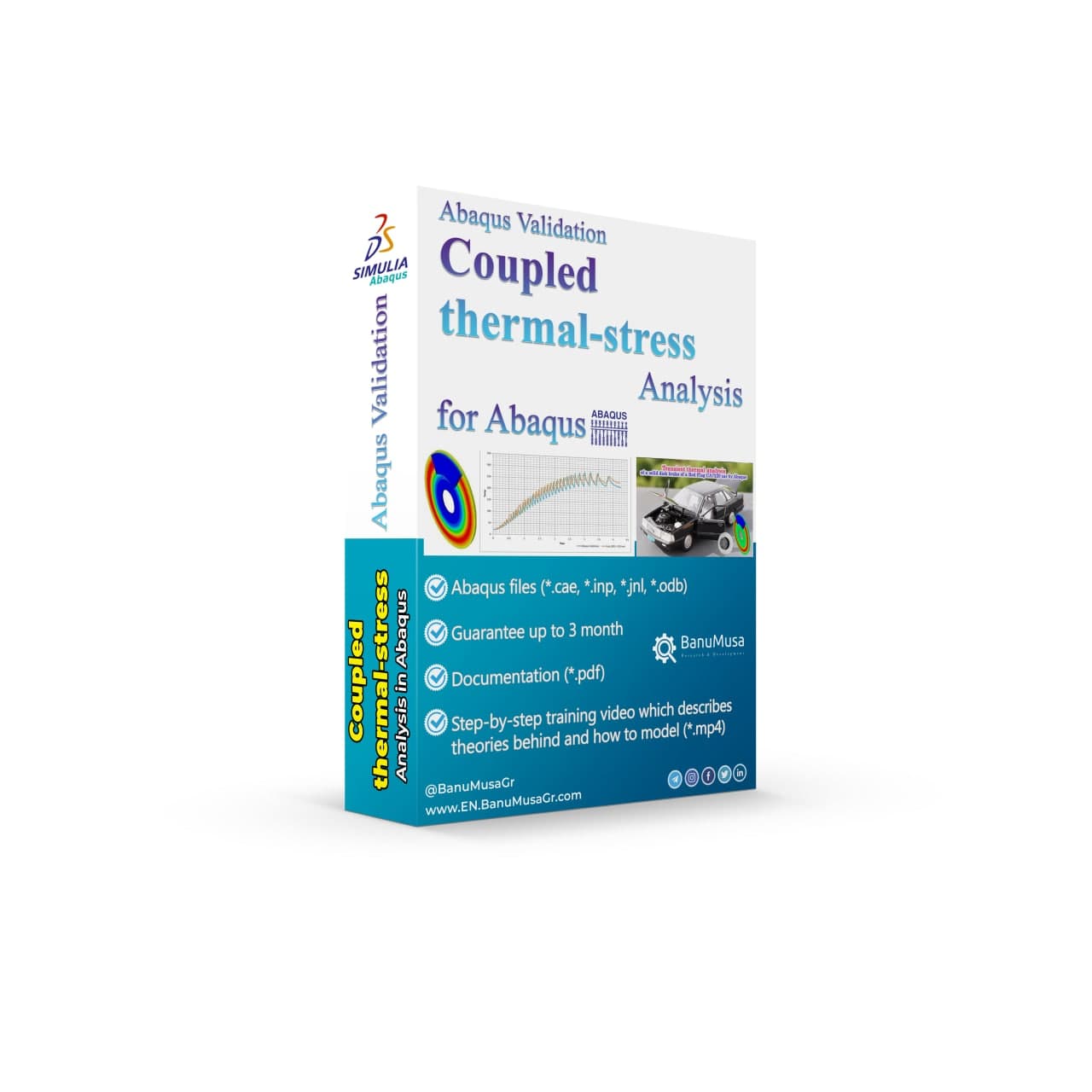
Coupled Thermal Stress Analysis of Automotive Disc Brake: A Complete Validation Tutorial
In Coupled Thermal Stress Analysis of Automotive Disc Brake: A Complete Validation Tutorial, a solid disk brake of a CA7220 car with initial rotational velocity will contact a disk pad. The effects of friction will be an increase in disk temperature due to heat generated by energy dissipation and the reduction of rotational velocity. The numerical results were validated by the Gao & Lin, (2002) paper.
Abaqus tutorial video (*.mp4)
Abaqus files (*.cae, *.inp, *.jnl, *.odb)
15-day money-back guarantee
Free 24/7 online mentoring