
 View Large
Non-Linear Springback Analysis and Precision Bending Die Compensation for AISI 304L Sheet Metal
Project Overview
| Parameter | Specification |
| Industry | Tooling & Die Manufacturing, Sheet Metal Forming, Automotive |
| Material | Austenitic Stainless Steel AISI 304L (ASTM A240 Standard) |
| Software Used | Abaqus/Explicit, Abaqus/Standard, SolidWorks CAD |
| Methodology | Non-linear combined isotropic-kinematic hardening (Chaboche), Explicit-to-Implicit springback transfer |
| Key Result | Reduced angular error from 4.2° to ±0.35°, eliminating 3 physical die re-machining cycles |
1. The Engineering Challenge: The Failure of Analytical Models
In precision sheet metal bending, controlling elastic recovery—known as springback—is a primary engineering bottleneck. Austenitic stainless steel (AISI 304L) exhibits a high yield-to-modulus ratio (σ_y / E), leading to severe post-unloading geometric deviations.
Standard toolmaking workflows often rely on classical empirical approximations, such as the Gardiner formula:
(Ri / Rf) = 4 * ((Ri * σy) / (E * t))³ – 3 * ((Ri * σy) / (E * t)) + 1
Where:
- Ri: Initial punch radius (mm)
- Rf: Final bend radius after springback (mm)
- σy: Material yield strength (MPa)
- E: Elastic modulus (GPa)
- t: Sheet thickness (mm)
Why Classical Hand Calculations Fail in Production
- Bauschinger Effect & Stress Reversal: Analytical solutions assume simple isotropic behavior, neglecting kinematic hardening during reverse bending as the sheet conforms across die corners.
- Contact Pressure Redistribution: Dynamic friction and punch/die corner wear non-linearly alter the neutral axis position.
- Anisotropic Plastic Flow: Sheet rolling texture creates directional yield variations not captured by basic formulas.
In our client’s initial tooling trials, analytical estimates resulted in an angular deviation exceeding 4.2°, threatening severe project delays and costly CNC rework of hardened tool-steel dies.
2. Advanced Springback Analysis in Abaqus: Explicit-to-Implicit Methodology
To deliver tooling geometry that meets manufacturing tolerances on the first physical press stroke, BanuMusa R&D implemented a two-stage finite element framework based on validated continuum mechanics:
- Stage 1 (Abaqus/Explicit): Dynamic forming and punch travel capturing contact, inertia, and non-linear plasticity.
- Stage Transfer: Stress and strain tensor mapping process.
- Stage 2 (Abaqus/Standard): Static unloading and springback equilibrium calculation.
- CAD Compensation: Reverse die surface compensation exported directly to CNC milling toolpaths.
Looking for Similar Engineering Results?
Don't let complex simulation challenges slow down your R&D. Our expert team at BanuMusa R&D is ready to provide tailored, highly accurate FEA and CFD solutions for your specific industry.
Request a Similar Simulation ProjectDetailed Technical Implementation Steps:
- Constitutive Hardening Calibration: Calibrated a combined isotropic-kinematic hardening model (Chaboche plasticity) using cyclic tension-compression test curves. This captured the transient Bauschinger effect during tool unloading far better than standard isotropic yield laws.
- Forming Simulation (Abaqus/Explicit): Modeled high-contact non-linearities, sheet blank holding pressure, and punch travel while monitoring the kinetic-to-internal energy ratio to maintain quasi-static fidelity (E_kin < 5% E_int). For more details on finite element fundamentals, refer to the SIMULIA Abaqus Documentation.
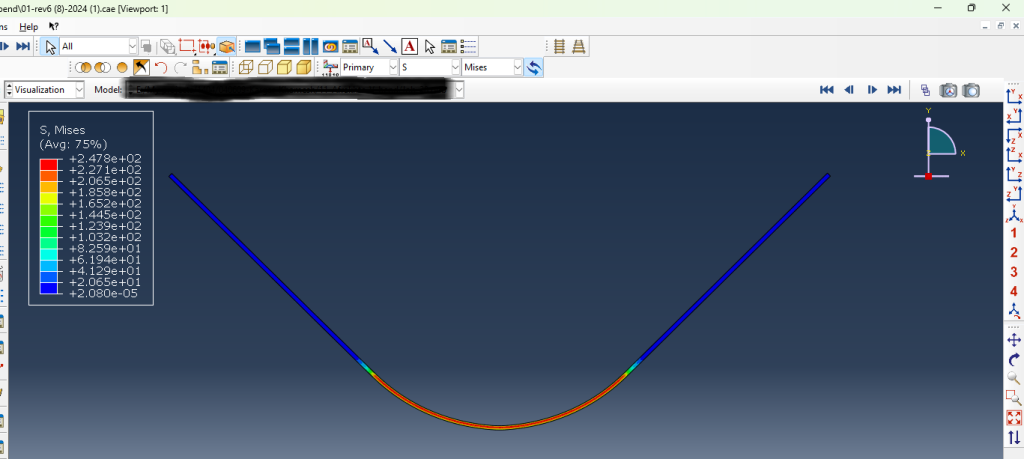
- Springback Simulation (Abaqus/Standard): Transferred the stress-strain state, boundary conditions, and deformed mesh into an implicit solver to achieve static equilibrium post-tool removal.
- Material Standards Reference: Baseline mechanical properties for 304L stainless steel were benchmarked against the ASM International Materials Database.
- Reverse Die Compensation: Extracted nodal displacement field vectors to compute inverse surface compensations, updating the CNC milling toolpaths for the punch and die cavities.
3. Results & Industrial ROI
- Angular Accuracy: Part angular deviation reduced from +4.2° (uncompensated) to ±0.35° (FEA-compensated).
- Tooling Cost Reduction: Completely eliminated 3 physical try-out and CNC EDM re-machining cycles.
- Lead Time: Reduced the tooling commissioning timeline from 6 weeks to 10 days.
 4. Value Delivered Across Stakeholders
For OEMs & Toolmakers (Industrial B2B)
- First-Time-Right Tooling: Eliminate “trial-and-error” die rework by validating sheet metal forming through virtual press trials.
- Material Cost Optimization: Identify optimal blank holder forces and reduce scrap rates across high-strength steel and aluminum alloys.
For Researchers & Academic Scholars
- Advanced Constitutive Modeling: Explore state-of-the-art hardening laws, anisotropic yield functions (Hill48, Barlat Yld2000), and subroutine integrations (UMAT / VUMAT).
- Solver Transfer Techniques: Master the explicit-to-implicit mapping workflow in Abaqus for robust springback and residual stress prediction.
5. Related CAE Capabilities & Engineering Services
- Finite Element Analysis (FEA) Consultancy Services
- Calibration of Materials for Simulation
- MatLib: Standardized Material Library for Abaqus
- Academic Request & Research Support
Ready to Eliminate Tooling Trial-and-Error?
Whether you need precision springback compensation, deep drawing simulation, or custom material subroutine development:
📩 Request an Engineering Consultation or email our technical lead directly at info@banumusagr.com.
Accelerate Your Engineering Projects with BanuMusa R&D
Struggling with complex simulations, material calibration, or convergence issues? We provide professional solutions to guarantee your R&D success:
- 🚀 FEA & CFD Consultancy: Outsource your toughest structural, thermal, and fluid dynamics challenges to our industry experts.
- 🎓 Technical Abaqus Mentoring: Get 1-on-1 professional guidance to overcome specific modeling bottlenecks and save weeks of trial and error.
- 📚 Abaqus Material Library (MatLib): Skip manual mathematical calibration. Download hundreds of scientifically validated material models instantly.