
The Ultimate Guide to FRP Composite Failure Criteria in FEA
When we come to finite element failure analysis in Fiber-Reinforced Polymer (FRP) laminates, choosing the appropriate criteria and material model to predict failure and damage is the first critical question.
Does this criterion have the ability to correctly predict damage and failure in the FRP composite? How do we determine its constants? Which of the failure criteria has better accuracy? How about damage evolution?
In this comprehensive guide, we review the most valid FRP composite failure criteria implemented in finite element analysis software (like Abaqus and LS-Dyna) and show you how to apply them using advanced engineering tools. (Note: This article focuses strictly on intra-laminar failure. Interlaminar failure/delamination will be covered in future publications).
The Challenge of Defining “Failure” in Composites
The difficulty of composite analysis can be understood from the fact that, according to the International Association for the Engineering Modelling, Analysis and Simulation Community (NAFEMS):
“There is no universal definition for what constitutes the ‘failure’ of an FRP composite.”
However, in the vocabulary of failure engineering, it is generally defined as:
‘Failure’ is the point beyond which the structure or component ceases to fulfill its function.
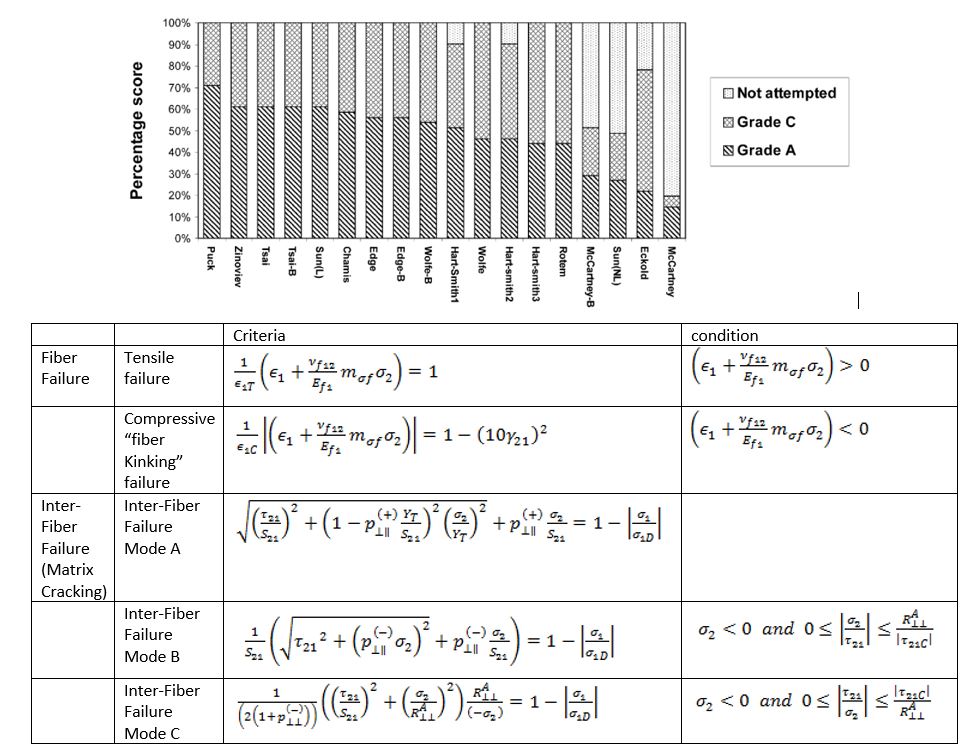
In 2002, Kadoun and Hinton launched the “World Wide Failure Exercise (WWFE)” to establish a benchmark because, at the time, no single damage theory was deemed credible for all practical engineering applications. Since then, the evolution of Failure Analysis and computational power has dramatically changed the landscape.
Physical vs. Non-Physical Basis Failure Criteria
Fiber-reinforced polymer composite materials exhibit several distinct damage modes (fiber tension, matrix compression, etc.), and each mode requires a specific failure criterion. The need to predict the failure of FRP composites has led to many theories, classified by Echabi and Paris into two main categories:
1. Non-Physical Basis Criteria (Mathematical Interpolation)
These criteria are not related to specific failure modes. They are expressed using a mathematical relationship—generally in a polynomial or quadratic form—and predict failure by interpolating experimental results.
Limitation: In this type of failure criteria, there is no attempt to specify the exact location or modes of failure (e.g., whether the fiber broke or the matrix cracked).
Example: Tsai-Wu and Tsai-Hill.

2. Physical Basis Criteria (Mode-Specific)
These criteria relate directly to the physical phenomenological failure modes of the composite laminate. They require more material properties but provide a much deeper understanding of the damage evolution.
Example: Hashin, Puck, and LaRC05.
Every failure criterion has tradeoffs in terms of accuracy, conservatism, and complexity. The actual criterion used depends on the specific application, tolerable risks, and your simulation software capabilities.
Widely Used Failure Criteria for FRP Composite Materials
The most famous and widely used failure criteria for composite materials range from simple interpolations to sophisticated multi-axial models. Here is a comparison:
- Maximum Stress / Strain Criteria: Failure occurs when the maximum stress/strain in either the fiber or matrix reaches its respective ultimate limit. Simple, conservative, but less accurate for complex loading.
- Tsai-Hill & Azzi-Tsai-Hill Failure Criteria: Early interactive failure criteria based on the distortion energy theory.
- Tsai-Wu Failure Criterion: A highly popular quadratic tensor polynomial criterion. It is mathematically elegant and easy to implement but falls under the “non-physical” category, meaning it cannot distinguish between failure modes.
- Hoffman Failure Criterion: Similar to Tsai-Wu but accounts for different tensile and compressive strengths.
- Hashin Failure Criteria: A physical-basis model that separates criteria for fiber and matrix failures under tension and compression. It requires extensive material properties but predicts failure accurately under complex loading.
- Puck Failure Criteria: Advanced physical-basis criteria focusing heavily on matrix fracture planes.
- LaRC05 Failure Criteria: The Langley Research Center criteria accurately predict matrix and fiber failure, including critical in-situ effects.
Implementing Advanced Composite Failure Criteria in Abaqus
Knowing the theory is only half the battle. Implementing these advanced failure criteria into FEA software requires sophisticated computational tools. At Banu Musa R&D, we have developed solutions for the most powerful physical-basis criteria:
3D Hashin VUMAT Subroutine (For Solid Elements)
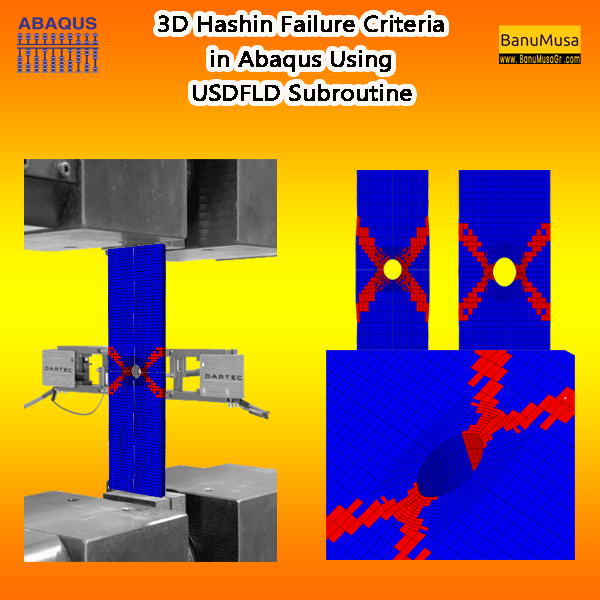
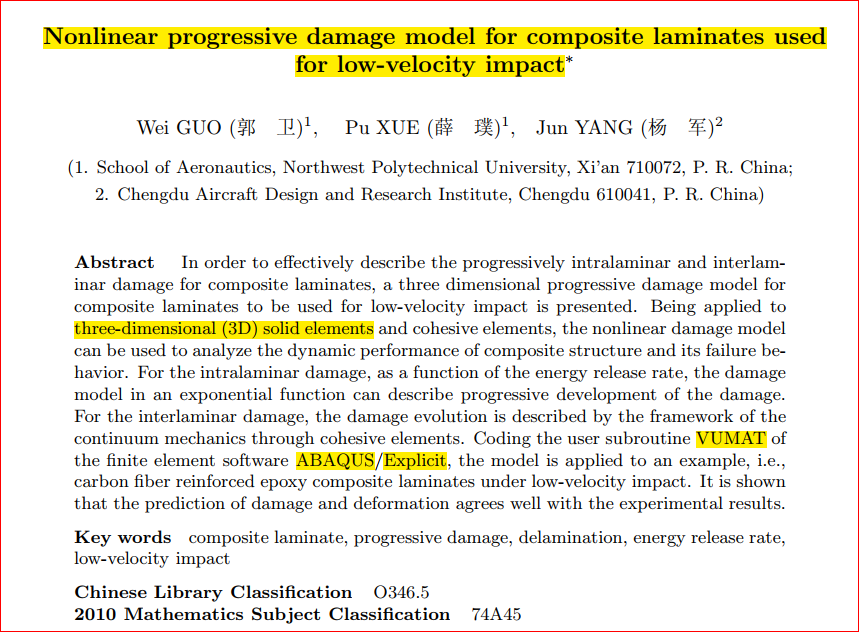
The built-in Hashin model in Abaqus only works for shell elements. If you are modeling thick laminates with 3D solid elements, you need a custom subroutine.
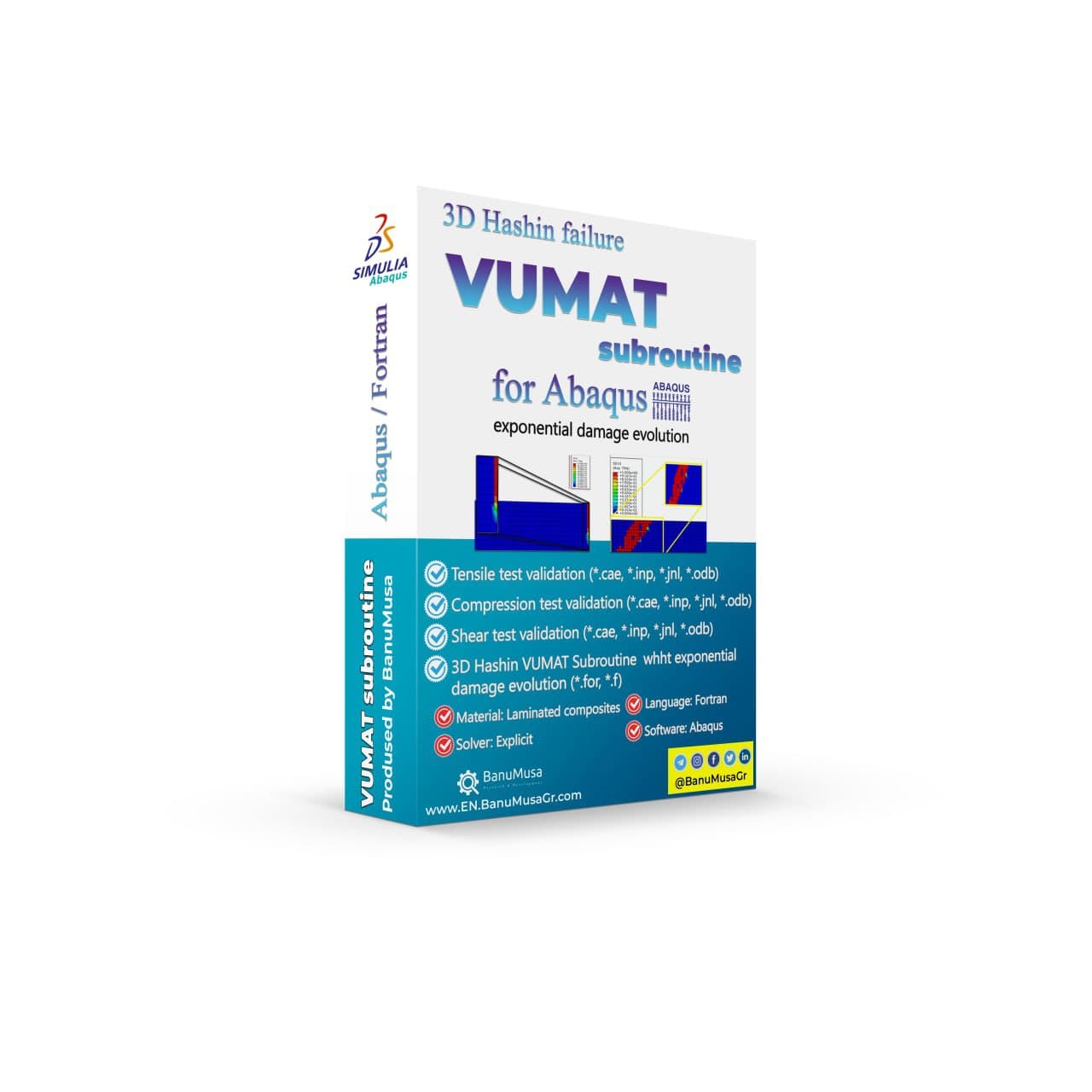
- 👉 Download the 3D Hashin VUMAT Subroutine for Abaqus (with Exponential Damage Evolution)
- 👉 Learn how to write a 3D Hashin USDFLD Subroutine
- 🎥 Watch the difference: 3D Hashin vs. Chang-Lessard Failure Criteria | Abaqus USDFLD Subroutine
LaRC05 Failure Criterion Implementation
If you want to implement the highly advanced LaRC05 model without writing complex Fortran code from scratch, our comprehensive tutorial provides the exact methodologies and scripts
- 👉 Abaqus Tutorial: LaRC05 Failure Criterion For Fiber-Reinforced Composites
- 🎥 Watch our tutorial: LaRC05 Composite Failure Criteria in Abaqus
Autodesk Helius PFA Integration
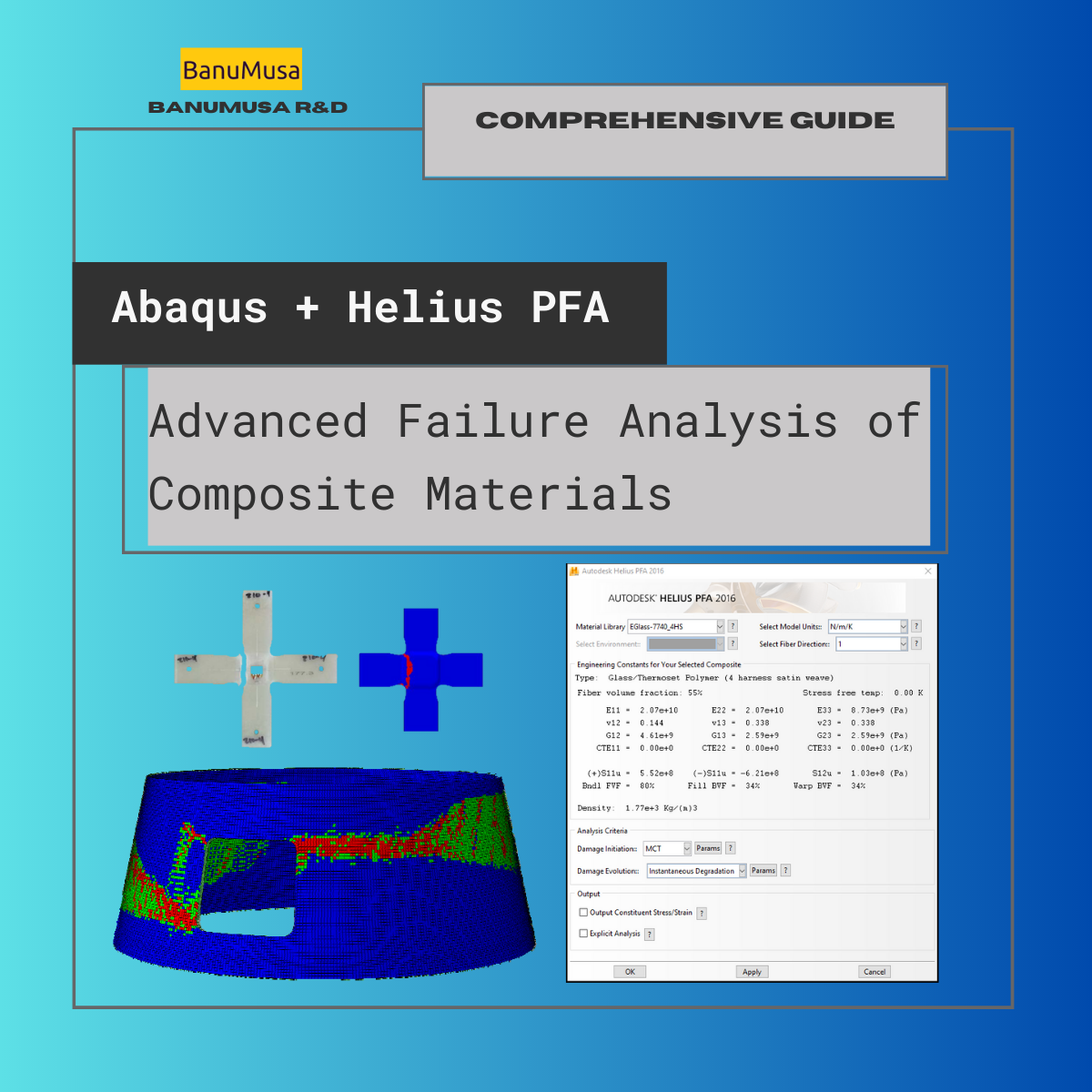
For engineers dealing with fatigue and progressive failure, linking Abaqus with Autodesk Helius PFA offers a massive library of pre-built criteria (including Hashin and Puck) specifically optimized for convergence
- 👉 Advanced Failure Analysis of Composite Materials with Abaqus and Autodesk Helius PFA
- 🎥 See it in action: Static Damage of Wind Turbine Composite Blade with Abaqus and Helius PFA
Real-World Application: Banu Musa R&D Composite Projects
The theoretical criteria discussed above are actively used by our engineering team to solve high-stakes industrial problems. Explore our portfolio to see these criteria applied in real-world scenarios:
- Progressive Damage Modeling Composite Laminates under Hypervelocity Impact
- Low-Velocity Impact Damage in Composite Overwrapped Pressure Vessel (COPV)
- Fatigue and Static Damage in Chopped Composite Sheets
If you are dealing with filament winding, our Wound Composite Modeler (WCM) Plugin can help you generate accurate fiber orientations before applying any failure criteria.
Accelerate Your Engineering Projects with BanuMusa R&D
Struggling with complex simulations, material calibration, or convergence issues? We provide professional solutions to guarantee your R&D success:
- 🚀 FEA & CFD Consultancy: Outsource your toughest structural, thermal, and fluid dynamics challenges to our industry experts.
- 🎓 Technical Abaqus Mentoring: Get 1-on-1 professional guidance to overcome specific modeling bottlenecks and save weeks of trial and error.
- 📚 Abaqus Material Library (MatLib): Skip manual mathematical calibration. Download hundreds of scientifically validated material models instantly.