


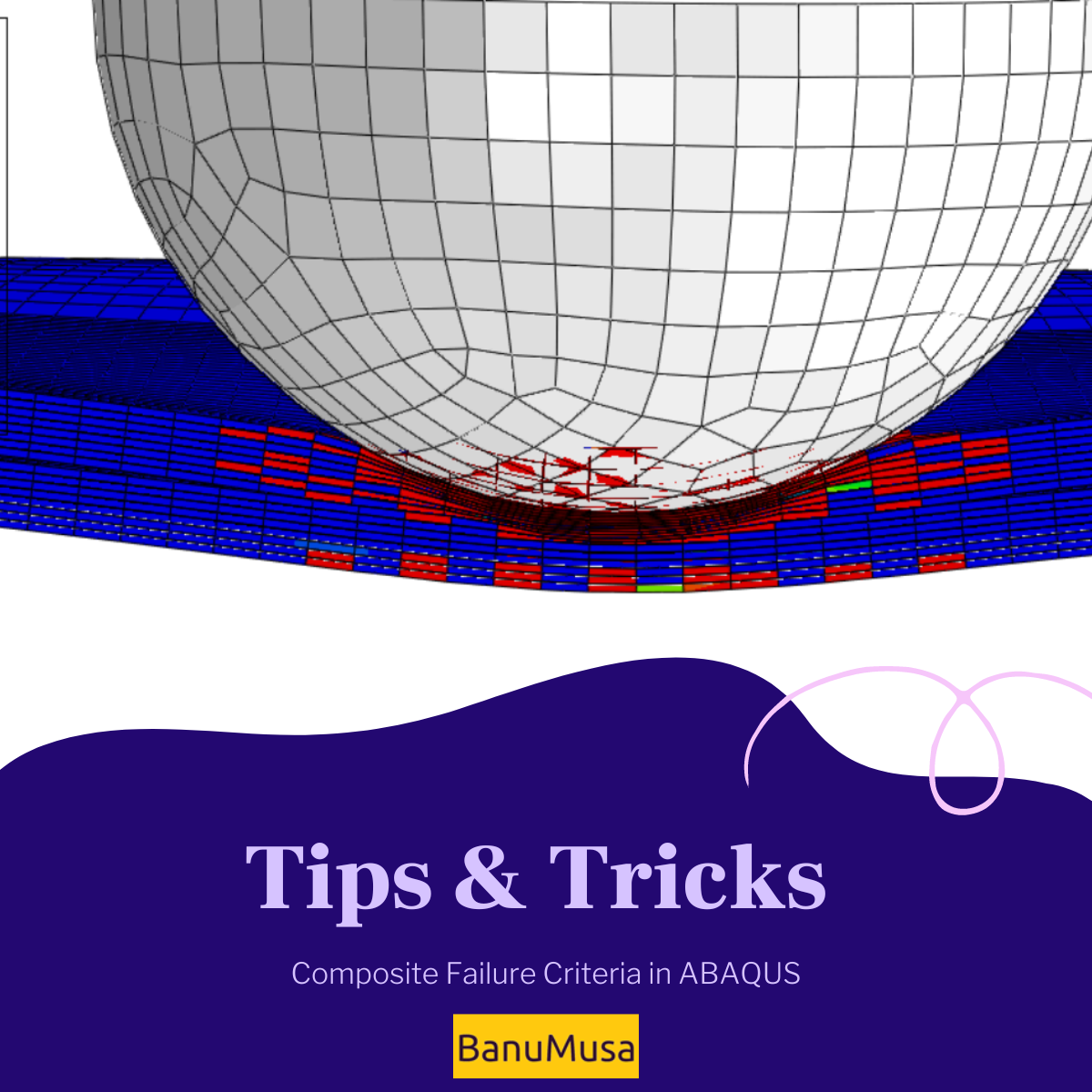
Advanced Guide to Composite Failure Criteria in Abaqus
Analyzing the progressive damage of Fiber-Reinforced Polymer (FRP) composites is one of the most complex challenges in finite element analysis. Based on more than 10 years of industrial experience at BanuMusa R&D in composite failure analysis, this guide provides definitive solutions for selecting and implementing the right composite failure criteria in Abaqus.
The Big Question: Can You Use 3D Hashin for Solid Elements?
Direct Answer: No. The built-in Hashin damage model in Abaqus is mathematically formulated exclusively for plane stress elements (such as conventional shells, continuum shells, and membranes). It adjusts strictly to lamina elastic behavior. Therefore, you cannot directly apply the built-in Hashin criteria to 3D solid elements (like C3D8R) for thick FRP composite laminates.
However, the good news is that by leveraging User Subroutines (Fortran), you can implement any 3D composite failure criteria into Abaqus.
Built-in Material Models vs. Custom Subroutines
In Abaqus, there are several failure criteria and damage models for FRP composite materials, each with its own specific limitations. Here is a breakdown of your options:
1. 2D Hashin Failure Criteria (Built-in)
- Advantage: It supports damage evolution and distinctly displays specific damage modes, such as fiber breakage and matrix cracking in both tension and compression.
- Limitation: It is restricted to plane stress elements. If your project requires solid elements, this built-in model will fail. Instead, delamination should be handled using Cohesive Zone Modeling
2. Tsai-Hill & Tsai-Wu Criteria
Limitation: Similar to the built-in Hashin model, these classic criteria are not applicable to solid elements. Furthermore, they only predict failure initiation and do not support damage evolution (progressive stiffness degradation).
3. LaRC05 Failure Criteria
The LaRC05 (Langley Research Center) criterion is a highly advanced, physically-based model that accurately predicts matrix and fiber failure, including in-situ effects. It can be utilized in the Abaqus/Standard solver by writing UVARM and UDMGINI subroutines. You do not need to write this complex code from scratch. Learn more in our Abaqus Tutorial: LaRC05 Failure Criterion for FRP Composites.
🎥 Watch our video tutorial on YouTube: LaRC05 Composite Failure Criteria in Abaqus
Writing Fortran User Subroutines for 3D Elements
When you are forced to use 3D solid elements, writing user subroutines is the only path forward. You will need to develop USDFLD, VUSDFLD, UMAT, or VUMAT scripts to apply 3D Hashin or Puck failure criteria.
Developing a robust subroutine requires deep knowledge of continuum mechanics and Fortran programming. (If you are new to coding in Abaqus, we highly recommend starting with our Comprehensive Fortran Training for Abaqus Subroutines).
The Ultimate 3D Solutions:
Download the 3D Hashin VUMAT Subroutine: Features progressive failure analysis, exponential softening behavior, and exceptional computational speed.
Complete USDFLD / VUSDFLD Training: Learn how to implement failure criteria using field variables in Abaqus.
🎥 Watch our comparison video on YouTube: 3D Hashin vs. Chang-Lessard Failure Criteria | Abaqus USDFLD Subroutine.
Watch our demonstration of the 3D Hashin VUMAT simulating exponential composite damage evolution in Abaqus/Explicit :Watch the demonstration of the 3D Hashin VUMAT in Abaqus/Explicit
3D Hashin VUMAT Subroutine for Abaqus with Exponential Damage Evolution
Simulating Progressive Fatigue with Autodesk Helius PFA
Another highly efficient alternative to writing raw Fortran code is using the Autodesk Helius PFA plug-in. Helius PFA integrates directly with Abaqus and provides a massive library of advanced failure criteria for composite materials. Its most powerful feature is the ability to simulate and analyze the progressive fatigue of composite structures without convergence issues. 👉 Master this tool here.
🎥 Watch our practical simulation example on YouTube: Static Damage of Wind Turbine Composite Blade with Abaqus and Helius PFA.
Advanced Failure Analysis of Composite Materials with Abaqus and Autodesk Helius PFA: A Comprehensive Guide
Banu Musa R&D Composite Case Studies & Advanced Tools
At Banu Musa R&D, we bridge the gap between theoretical failure criteria and real-world industrial applications. Here are some of our advanced composite engineering projects and specialized plugins:
Industrial Composite Projects:
- Progressive Damage Modeling under Hypervelocity Impact: Advanced aerospace simulation predicting catastrophic failure under extreme kinetic energy.
- Low-Velocity Impact Induced Damage in Overwrapped Pressure Vessels: Identifying critical damage thresholds and matrix cracking in Type IV pressure vessels.
- Fatigue & Static Damage in Chopped Composite Sheets: Analyzing micro-mechanical failure initiation and progressive degradation.
Watch our tutorial on Low-Velocity Impact on Laminated Composite Plates (LS-Dyna & Abaqus techniques):
https://www.youtube.com/watch?v=EwFpU1k_sZY
Specialized Composite Simulation Tools:
- Wound Composite Modeler (WCM) Plugin: The ultimate tool for generating finite element models of filament-wound composite structures.
- Micromechanics Plugin for Abaqus: Perform multi-scale modeling to determine effective properties at the fiber/matrix level.
- Design & Analysis of Composite Pressure Vessels Course: A masterclass on simulating Type IV vessels.
Accelerate Your Engineering Projects with BanuMusa R&D
Struggling with complex simulations, material calibration, or convergence issues? We provide professional solutions to guarantee your R&D success:
- 🚀 FEA & CFD Consultancy: Outsource your toughest structural, thermal, and fluid dynamics challenges to our industry experts.
- 🎓 Technical Abaqus Mentoring: Get 1-on-1 professional guidance to overcome specific modeling bottlenecks and save weeks of trial and error.
- 📚 Abaqus Material Library (MatLib): Skip manual mathematical calibration. Download hundreds of scientifically validated material models instantly.