

Facebook Twitter Email Instagram YouTube linkedin WhatsApp WhatsApp VK Telegram
info@BanuMusaGr.com
Login / Register
0 Wishlist
0 Compare
0 items / € 0.00
Facebook Twitter Email Instagram YouTube linkedin WhatsApp WhatsApp VK Telegram
FEA & CFD Consultancy | BanuMusa R&D FEA & CFD Consultancy | BanuMusa R&D
  • Consulting Services
  • Products
  • Resources
    • Blog
    • Projects
  • About Us
    • Contact Us
    • Our Team
    • Our Partners
    • Careers
    • Payment Methods
    • Support & FAQ
Free Mentoring
Menu
FEA & CFD Consultancy | BanuMusa R&D
0 items / € 0.00
HomeShopAbaqusAbaqus Subroutines Porous Elastomers Abaqus UHYPER Subroutine
Previous product
larc05-abaqus-failure-criteria-composite-analysis
Abaqus Tutorial: LaRC05 Failure Criterion For Fiber-Reinforced Composites € 110.00 Original price was: € 110.00.€ 99.00Current price is: € 99.00.
Back to products
Next product
umat-vumat-subroutine-gtn-damage-model-abaqus
VUMAT Subroutine: Shear Anisotropic Modified GTN Damage Model € 535.00 Original price was: € 535.00.€ 490.00Current price is: € 490.00.
Porous Elastomers Abaqus UHYPER Subroutine
Watch video
Click to enlarge

Porous Elastomers Abaqus UHYPER Subroutine

€ 55.00

The ” Porous Elastomers Abaqus UHYPER Subroutine ” product implements the hyperelastic energy density derived for the macroscopic elastic response of non-Gaussian elastomers weakened by an isotropic and non-percolative distribution of equiaxed pores. This result is valid for any choice of I1-based incompressible energy density characterizing the non-Gaussian isotropic elastic response of the underlying elastomer.

Lecture notes (PDF)
  5 Abaqus example files (cae, inp, jnl, odb)
FORTRAN UHYPER subroutine run on Windows or Linux
15-day money-back guarantee
Free 24/7 online mentoring

If you want to pay in a way other than Tether/Tron, contact us.
somdn_product_page
Compare
Add to wishlist
SKU: 006 Categories: Abaqus, Abaqus Subroutines
Share
Facebook Twitter Email Pinterest linkedin Odnoklassniki WhatsApp WhatsApp VK Telegram
close
Products
  • Modeling Rubber and Viscoelasticity with Abaqus tutorial course Modeling Rubber and Viscoelasticity with Abaqus € 550.00
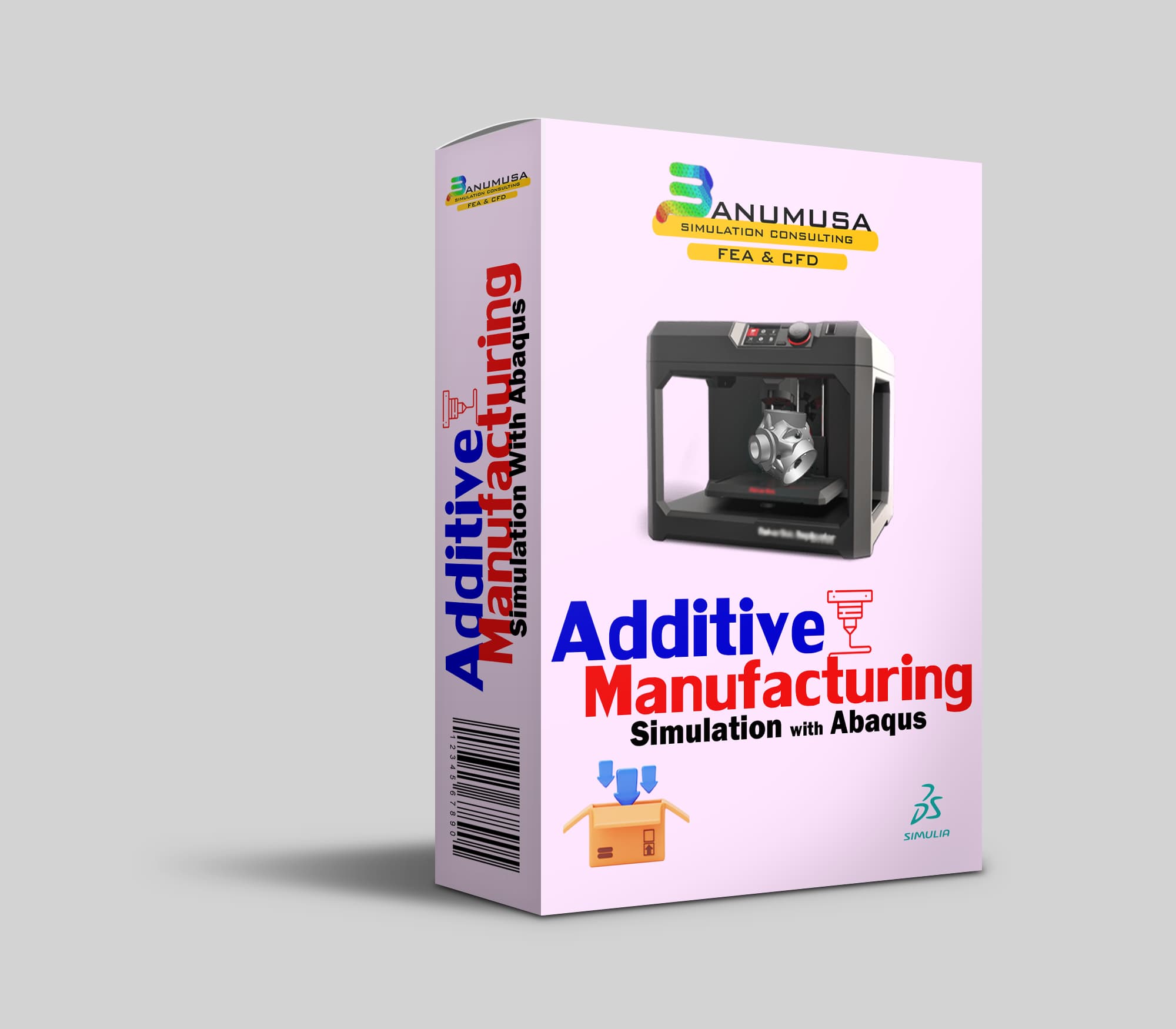
  • Additive Manufacturing Simulation with Abaqus Additive Manufacturing Simulation with Abaqus € 410.00
  • Description
  • Additional information
  • Payment & Delivery
  • Content
Description

Porous Elastomers Abaqus UHYPER Subroutine

The Abaqus material model library does not have a material model for porous elastomers. For this purpose, in order to model and analyze these materials, it is necessary to write the constitutive model of the material in a user subroutine. In Abaqus, the UHYPER subroutine is the best option for defining the hyperelastic material model. To avoid wasting your time with writing subroutines, you can use Porous Elastomers Abaqus UHYPER Subroutine. Along with the UHYPER subroutine, several examples are included to ensure the accuracy of the code.

Hyperelastic Material Models

Modeling porous elastomers in Abaqus requires using a hyperelastic material model along with a user subroutine to define the porous material behavior. Abaqus has several hyperelastic material models that are well-suited for modeling elastomers and rubber-like materials. These models define the stress-strain behavior using strain energy potential functions instead of elastic moduli. Common hyperelastic material models in Abaqus include:

  • Neo-Hookean
  • Ogden
  • Mooney-Rivlin
  • Yeoh
  • Marlow
  • Arruda-Boyce
  • Van der Waals
  • Polynomial form

To capture the effects of porosity on the hyperelastic material behavior, a user subroutine is needed.

What Is UHYPER User Subroutine?

A UHYPER user subroutine is a user-defined hyperelastic material model subroutine in Abaqus. Abaqus has several built-in hyperelastic material models to represent the nonlinear behavior of rubber-like materials. However, these standard models often cannot adequately capture the full stress-strain behavior of certain materials.

A UHYPER subroutine allows users to define a custom hyperelastic material model to more accurately represent a specific material’s behavior. A UHYPER subroutine defines as:

  1. A user-defined strain energy potential function – The strain energy potential function (W) defines the strain energy stored in the material as a function of the strain invariants.
  2. Derivatives of the strain energy potential – The 1st and 2nd derivatives of W with respect to strain invariants, which are needed to calculate stress and elasticity tensors.
  3. Additional data – The UHYPER subroutine can also define additional material properties, damage variables, temperature dependence, etc.

A UHYPER subroutine allows you to more accurately model the hyperelastic behavior of soft materials that cannot be modeled well using Abaqus’ standard hyperelastic material models alone. The user-defined strain energy potential function can capture any nonlinearities and anisotropy in the actual material’s behavior.

What Are Porous Elastomeric Materials?

Porous elastomeric materials are a class of rubber and polymer materials that have a cellular structure with voids, pores, or holes within the material. Porous elastomeric materials are widely used in industrial and commercial applications, especially as shock absorbers, dampers, packaging materials, etc.

Oftentimes these applications involve very large deformations of the material. From a product design and performance perspective, engineers are usually interested in the macroscopic response of these materials and their interaction with other components in an assembly. Appropriate modeling of the macroscopic mechanical response of these materials under arbitrarily large deformations is, therefore, the main requirement for engineering applications.

Constitutive Model

Several constitutive models have been proposed in recent years to describe the macroscopic elastic response of porous elastomers based on homogenization solutions. Among those, the model proposed by Shrimali et al. is remarkably simple, accurate, and very suitable for implementation in Abaqus using the UHYPER user subroutine.
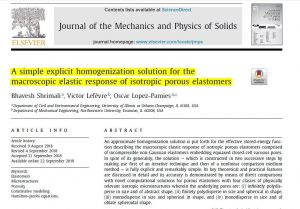
Porous Elastomers Abaqus UHYPER Subroutine - Validation paper

Examples & Workshops

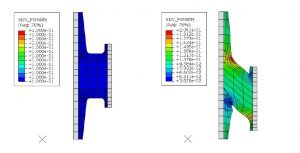
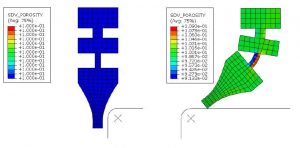
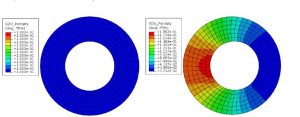
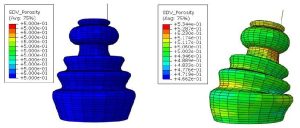
To demonstrate the applicability of the UHYPER user subroutine, several practical examples are presented which are based on models already available in the Abaqus Example Problems Manual. The details of the model setup can be found in the product.

Example 1: Rubber bushing model rubber bushing uhyper abaqus
Example 2: Windshield wiper model windshield-wiper-uhyper subroutine abaqus
Example 3: Viscoelastic bushing model viscoelastic bushing uhyper subroutine abaqus
Example 4: Automotive boot seal model automotive boot uhyper subroutine abaqus
Example 5: Automotive boot seal model – 2 Dimensional

Money-Back Guarantee

15-Day

Money back gold guarantee - BanuMusaWe’re fully confident in the value and reliability of the product. If for any reason you are not completely satisfied, email us at info@BanuMusaGr.com within 48 hours of your purchase for a full refund.
Introduction

Additional information
Software

Abaqus FEA

Payment & Delivery
All products available on the website come with a guarantee of customer satisfaction. The products can be used immediately after purchase through the download link. There is also online consulting/mentoring for all customer reassurance products.
Before buying, you can also talk to our experts in BanuMusa R&D and buy from the Shop according to your needs.

Note:

Please pay attention to the following points when you pay.

1. Tether / Tron The easiest way to pay is through the Tether portal in the BanuMusa shop. You can easily pay with your wallet.

• How to pay for a product using USDT TRC-20 with ADVCash https://www.youtube.com/watch?v=DYyHsdcLxhk

• Tron TRC20 Wallet for USDT Tutorial (Send USDT for Lowest Fees!!) https://www.youtube.com/watch?v=lBQMkEBf7W4

For other wallets just search on YouTube!

The download link automatically will be sent to you.

2. Payoneer:

If you have Payoneer, you can pay simply through the following ID.

fro458nk@gmail.com

After your payment is processed, you will receive the download links.

Let me know if you need any further adjustments!

3. PAYEER

Send us a message/ email to help you how to pay for this method, please. (info@banumusagr.com)

4. WebMoney

We will send you the wallet if you request this method. Email us.

5. PayPal Payment Instructions:

Please email us to send your PayPal Account.

After your payment is processed, you will receive the download links.

Let me know if you need any further adjustments!

6. SWIFT/IBAN

Another way is to pay via SWIFT or IBAN, contact us to learn more.

We will do our best to make sure you have a good shopping experience.


If it is not possible for you to buy through the Tether gateway, send us the link to the product using email (info@banumusagr.com) or social networks (WhatsApp, WeChat, Telegram). After that, the PayPal account will be sent to you.

Another way is to pay via SWIFT, contact us to learn more.


Ways to Contact Us:

WhatsApp / Telegram / WeChat: +98-915-5520-388
E-mail: info[at]banumusagr.com
Phone: +98-51-35424520

Payment Methods:

You can buy the product through Tether, Tron, Payoneer, PAYEER, WebMoney, PayPal, and SWIFT.

Content

What you will learn

  • PDF file Description of the hyperelastic model
  • 5 input example files ready to use in ABAQUS software
    • Example 1: Rubber bushing model
    • Example 2: Windshield wiper model
    • Example 3: Viscoelastic bushing model
    • Example 4: Automotive boot seal model
    • Example 5: Automotive boot seal model - 2 Dimensional
  • FORTRAN UHYPER subroutine run on Windows or Linux
Lecture notes (PDF)   5 example files (cae, inp, jnl, odb) FORTRAN UHYPER subroutine run on Windows or Linux 15-day money-back guarantee Free 24/7 online mentoring

Reviews

There are no reviews yet.

Be the first to review “Porous Elastomers Abaqus UHYPER Subroutine” Cancel reply

You must be logged in to post a review.

Related products

SlopeSR plugin for geotechnical Shear Strength Reduction and slope stability in Abaqus
Compare
Close

SlopeSR Plugin for Abaqus

€ 55.00
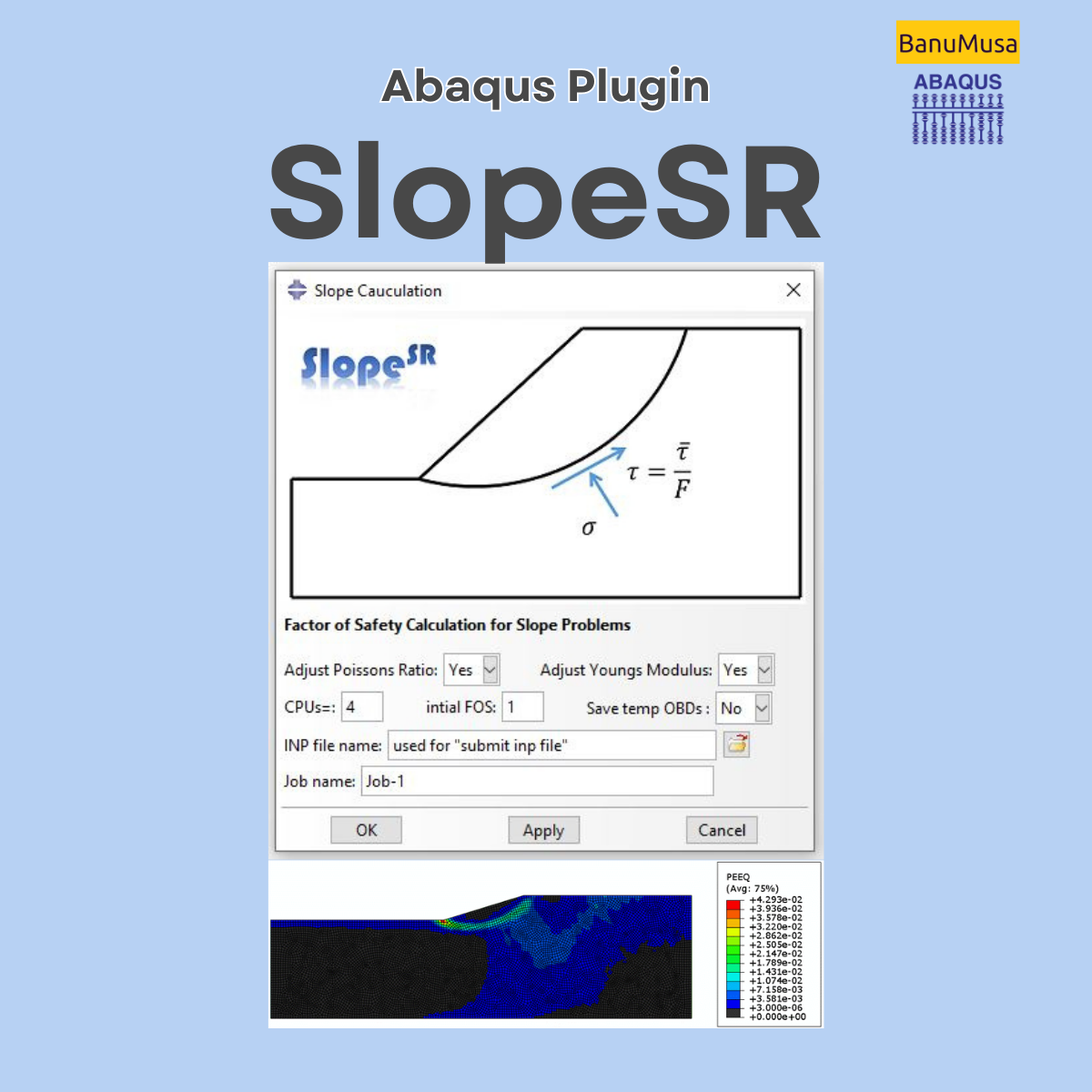
The SlopeSR Plugin for Abaqus is a GUI plug-in that uses the strength reduction method (SRM) to calculate the factor of safety (FoS) and critical slip surfaces for 2D and 3D slopes. It is designed for slope stability analysis in geomechanics and geotechnical engineering. The plugin allows users to solve a series of elastic-perfectly plastic problems with the strength parameters and the Mohr-Coulomb criterion in ABAQUS/CAE. Documentation (PDF ) Abaqus plugin files (*.RAR) Abaqus workshop files 15-day money-back guarantee   Free 24/7 online mentoring
Add to wishlist
Add to cart
Quick view
VUMAT JHB JH-2 ceramic model- Implementing Johnson-Holmquist model in Abaqus - JH-2 damage model VUMAT
Compare
Close

Abaqus VUMAT JHB and JH-2 Ceramic Model

€ 199.00
In Abaqus VUMAT JHB and JH-2 Ceramic Model tutorial course, you will learn how to use Built-in VUMAT subroutines in Abaqus to predict brittle materials (e.g. ceramic materials) damage using Johnson, Holmquist, and Beissel (JHB) and Johnson-Holmquist (JH-2) ceramic model. Also, 5 practical workshops show you how to define and use the subroutine, how to configure the model in Abaqus CAE, and how to visualize the results. There is also a JH-2 VUMAT subroutine Fortran file in this CAE package. In addition to the tutorial video, the Abaqus workshop files, & JH-2 VUMAT subroutine will be provided to you so that nothing will remain unclear. Also, all course includes free online 24/7 online tutoring after purchase. Abaqus tutorial video (*.mp4) Lecture notes (PDF) Abaqus workshop files (*.cae, *.inp, *.jnl, *.odb)  JH-2 Fortran VUMAT subroutine run on Windows or Linux 15-day money-back guarantee   Free 24/7 online mentoring
Add to wishlist
Add to cart
Quick view
Fitness-for-Service Analysis with Abaqus Course - ffs abaqus - ffs analysis
Level 3 assessment abaqus ffs analysis banumusa
Compare
Close

Fitness-for-Service Analysis with Abaqus Course

€ 550.00
In the Fitness-for-Service Analysis with Abaqus Course, participants will gain an in-depth understanding of assessing pressure vessels and piping equipment in accordance with industry standards such as ASME/API-579 Fitness-for-Service (FFS). The course focuses on utilizing Finite Element Analysis (FEA), specifically Level-3 stress analysis assessments, to evaluate equipment with complex geometries and varying loading conditions. Participants will learn techniques for modeling common pressure vessels like distillation towers and storage vessels using Abaqus/CAE. Additionally, the course covers the application and validation of loads such as the weight of contents, internal pressure, and more using Abaqus/Standard, which is essential for Level-3 FFS evaluations. Furthermore, procedures for analyzing metal loss through the finite element method, including mapping thickness readings from scans, will be discussed. This course is designed to enhance participants' expertise in utilizing Abaqus FEA simulation technology for making fitness-for-service (FFS) decisions on assets in the Petrochemical, Refinery, Oil & Gas industries, including pipelines, pressure vessels, heat exchangers, and more. Abaqus tutorial video (*.mp4) Lecture notes (PDF) Abaqus workshop files (*.cae, *.inp, *.jnl, *.odb) FFS Abaqus Plugins API 579 / ASME FFS-1 Standard 15-day money-back guarantee   Free 24/7 online mentoring
Add to wishlist
Add to cart
Quick view
Save Multiple Animations Plugin for Abaqus
Compare
Close

Save Multiple Animations Plugin for Abaqus

€ 0.00
Save Multiple Animations plugin allows the Abaqus user to create a unique animation file by joining different ODB files. Sometimes, due to the simulation workflow being needed, different models simulate a unique process, i.e. metal forming process. The results are, therefore, different *.odb files, and with this plug-in, the user can put them together in a unique file. The plug-in takes the current display on the viewport and applies it to all ODBs selected.  
Add to wishlist
View
Quick view
Autokeeler plugin generating Forming Limit Curves (FLC) and FLD in Abaqus
Compare
Close

Autokeeler Plugin for Abaqus: FLC & FLD Generator

€ 0.00

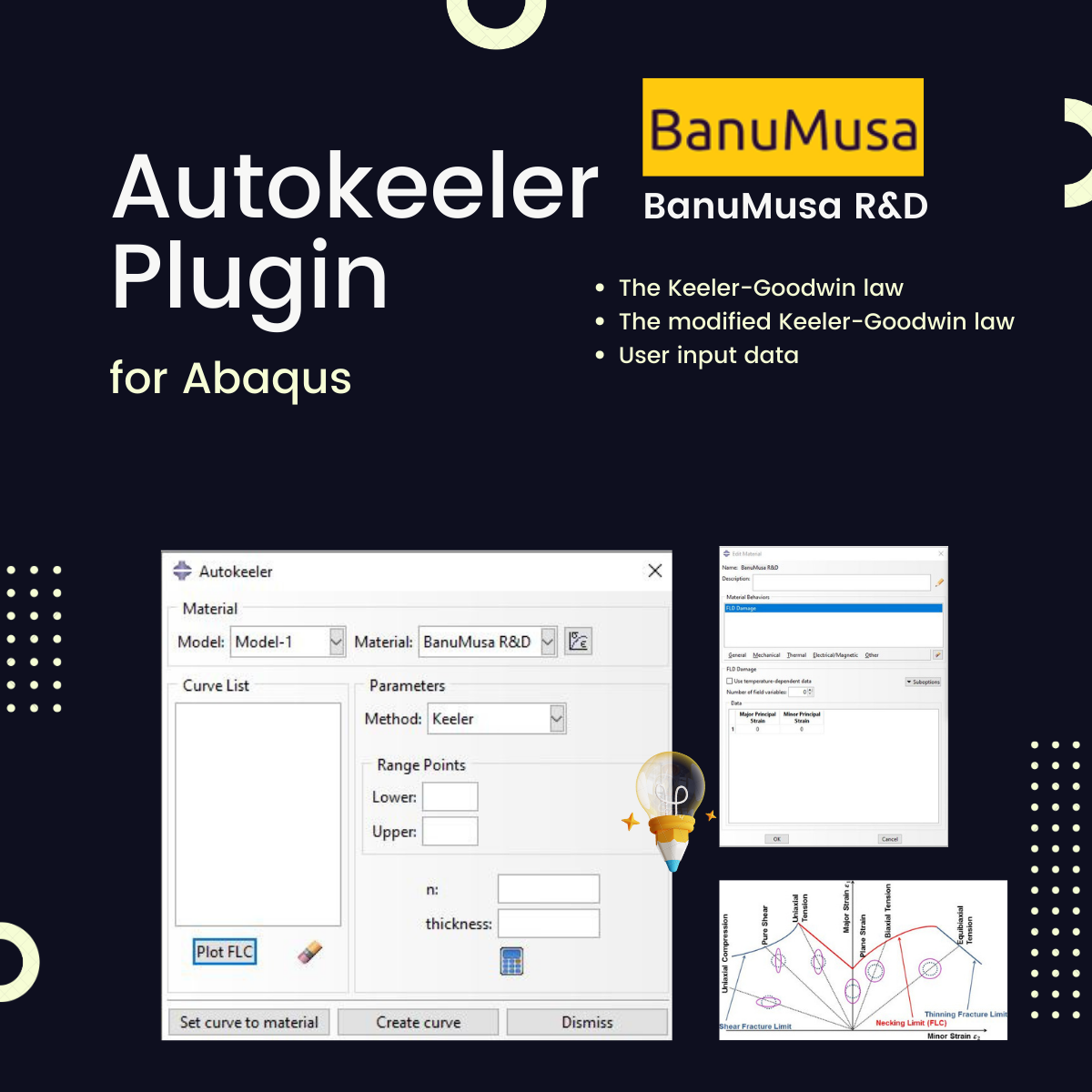
Easily generate Forming Limit Curves (FLC) and define Forming Limit Diagram (FLD) damage criteria in Abaqus. Includes comprehensive HTML & PDF documentation.

Add to wishlist
View
Quick view
Introduction to umat subroutine
Introduction to umat subroutie abaqus tutorial video writing umat subroutine
Compare
Close

Introduction to UMAT Subroutine

€ 210.00
Introduction to UMAT Subroutine course helps you to learn the process of writing UMAT as quickly as possible with the help of practical examples. All the tips and details that you encounter to write the code are taught in this course and you can implement the material model in the subroutine. Because you may have questions while watching the course, an expert will answer your questions online. Abaqus tutorial video (*.mp4) Lecture notes (PDF) Abaqus workshop files (*.cae, *.inp, *.jnl, *.odb) Fortran subroutines 15-day money-back guarantee   Free 24/7 online mentoring
Add to wishlist
Add to cart
Quick view
Johnson-Cook plugin for Abaqus
Compare
Close

Abaqus Johnson Cook Plugin: Free Material Calibration Tool

€ 0.00
Download the free Abaqus Johnson Cook plugin. Automate material calibration, calculate hardening parameters, and plot stress-strain responses instantly.
Add to wishlist
View
Quick view
online Technical Abaqus Mentoring by Skype and anydesk - banumusa - fea consulting
Compare
Close

Technical Abaqus Mentoring by Skype

€ 75.00
Our Technical Abaqus Mentoring by Skype service offers you the opportunity to engage in personalized one-on-one mentoring sessions via Skype and AnyDesk with our team of certified Abaqus specialists. This unique platform allows you to delve into your engineering challenges, providing you with expert guidance and support to navigate through any obstacles you may encounter. Our specialists are dedicated to steering you in the right direction, ensuring that you receive the assistance needed to overcome your technical hurdles effectively and efficiently.
Add to wishlist
Add to cart
Quick view

Tag your photos with #uhyper on Instagram.

University of Warwick
NBJX
MultiFat
kitech
kims
EnginSoft
Techinco
NIGC
Mobarakeh Steel Co.
Lincoln University
ISOICO Shipbuilding Company
IRISL Company
Ferdows Marine Tech
AQR Company

Founded in 2016, BanuMusa R&D is an established engineering consultancy specializing in advanced Finite Element Analysis (FEA), Computational Fluid Dynamics (CFD), and simulation-driven product development.

Facebook Youtube Linkedin Instagram

Products

  • 3D Hashin VUMAT Subroutine for Abaqus with Exponential Damage Evolution
  • VUMAT Subroutine: Shear Anisotropic Modified GTN Damage Model
  • MatLib Abaqus Material Library

Company


  • Contact us
  • Our team
  • Our partners
  • Careers

Our WeChat 

abaqus ansys lsdyna banumusa wechat

Copyright BanuMusa 2026
payments

Shopping cart

close

Powered by WhatsApp Chat

  • Menu
  • Categories
  • Consulting Services
  • Products
  • Resources
    • Blog
    • Projects
  • About Us
    • Contact Us
    • Our Team
    • Our Partners
    • Careers
    • Payment Methods
    • Support & FAQ
  • Consulting Services
  • Products
  • Resources
    • Blog
    • Projects
  • About Us
    • Contact Us
    • Our Team
    • Our Partners
    • Careers
    • Payment Methods
    • Support & FAQ

Sign in

close


Lost your password?
No account yet? Create an Account
Sidebar