 View Large
Underwater Explosion (UNDEX) Simulation and Marine Structural Response
Project Overview: Engineering Survivability Against Extreme Marine Shocks
Underwater Explosion (UNDEX) analysis is a critical requirement in the defense, marine, and offshore engineering sectors. The dynamic interaction between high-pressure shock waves, fluid cavitation, and structural deformation demands advanced Finite Element Analysis (FEA) to ensure the survivability of submarines, naval vessels, and offshore platforms.
At BanuMusa R&D, we specialize in the numerical modeling of UNDEX events, transitioning from expensive physical testing to high-fidelity Simulation-Driven Design. By utilizing advanced explicit solvers like Abaqus/Explicit and LS-DYNA, our engineering team accurately evaluates the structural integrity of marine assets against explosive detonations, ensuring compliance with global defense and maritime safety standards.
The Physics of UNDEX: Why is it More Destructive than Air-Blast?
An underwater explosion is a rapid chemical reaction occurring beneath the water’s surface, generating extremely hot gases (up to 3000°C) and high pressures (14 to 28 MPa). The fundamental difference between an air-blast and an UNDEX event lies in the thermophysical properties of the surrounding medium:
-
High Density and Inertia: Water is approximately 1000 times denser than air, meaning it transmits shockwave energy with significantly less attenuation.
-
Incompressibility: Water requires immense pressure (around 100 atm or 10 MPa) to compress. Consequently, the explosive energy is not dissipated through fluid compression but is instead transferred directly to the adjacent structures.
-
Cavitation and Bubble Dynamics: The initial shock wave causes a rapid pressure differential, leading to localized boiling or cavitation at the fluid-structure interface. Following the primary shock, the explosive gas bubble expands and collapses repeatedly. If this bubble collapses near a ship’s hull, it generates a high-velocity water jet capable of tearing through thick steel plates.
Due to these factors, a near-field UNDEX event beneath a ship’s bow can lead to catastrophic global whipping, structural failure, and eventual sinking.

Underwater explosion analysis (UNDEX)
Advanced Computational Methodologies for UNDEX at BanuMusa R&D
Simulating the free-surface effects, fluid-structure interaction (FSI), and cavitation during an UNDEX requires sophisticated numerical techniques. Our Finite Element Analysis (FEA) Consultancy team employs three primary methodologies depending on the project requirements:
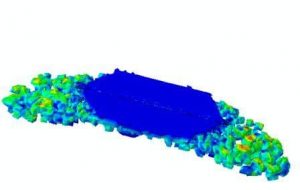
Underwater explosion analysis (UNDEX) with cavitation
1. Coupled Eulerian-Lagrangian (CEL) and ALE Methods (Abaqus & LS-DYNA)
For near-field explosions where extreme fluid displacement and bubble jetting are critical, we utilize Arbitrary Lagrangian-Eulerian (ALE) and CEL formulations. The fluid (water and explosive gas) is modeled in an Eulerian domain where the mesh is fixed and material flows through it, while the ship structure is modeled as a deformable Lagrangian body. This prevents the severe mesh distortion that traditionally plagues high-explosive simulations.
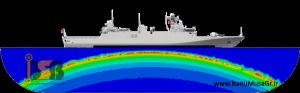
Explosion analysis using Abaqus and Ansys LS-DYNA
2. Pressure-Time Equivalence Method (Abaqus & LS-DYNA)
For far-field explosions where the primary damage mechanism is the acoustic shock wave rather than the bubble jet, we apply pressure-time equivalence methods. This approach applies the explosive pressure history directly to the structural wet surface, significantly reducing computational wall-clock time while maintaining high accuracy for global hull response.
3. Acoustic Fluid-Structure Interaction
To capture the effects of acoustic cavitation—where the absolute pressure in the water drops to the vapor pressure limit—we utilize acoustic elements coupled with structural elements. This method accurately predicts the reload shock caused by the closure of the cavitation zone against the hull.
(Note for the engineering team: For specific implementation of the SSA (Scattered Shock Approach) in LS-DYNA, please refer to our internal validation documents comparing LS-DYNA load_SSA keyword against Abaqus acoustic formulations.)
Looking for Similar Engineering Results?
Don't let complex simulation challenges slow down your R&D. Our expert team at BanuMusa R&D is ready to provide tailored, highly accurate FEA and CFD solutions for your specific industry.
Request a Similar Simulation ProjectProject Deliverables and Industrial Impact
By applying Design by Analysis (DBA) principles to UNDEX events, BanuMusa R&D provides clients with:
-
Failure Prediction: Accurate mapping of plastic strain, tearing, and rupture in hull plating and bulkheads.
-
Shock Mitigation: Optimization of anti-blast doors and energy-absorbing mounts for critical internal equipment.
-
Cost Reduction: Eliminating the need for highly restricted and expensive live-fire underwater tests.
Our UNDEX simulations are highly relevant for the design of:
-
Surface ships and submarine pressure hulls.
-
Offshore Floating Wind Turbines (FOWT) subjected to underwater acoustic shocks.
-
Subsea pipelines and underwater protective barriers.
Want to Learn Blast Modeling or Need Project Assistance?
If you are an engineer looking to master extreme dynamic events, we highly recommend exploring our specialized course: Blast and Explosion Modeling with LS-DYNA. This comprehensive training covers CONWEP, ALE fluid-structure mapping, and shockwave propagation.
Are you a University Researcher?
We actively support the academic community. MSc and PhD students researching high-velocity impacts or UNDEX phenomena can apply for our 40% Academic Discount Program to gain access to our tools and mentoring services. Request your discount here: Academic Request.
Outsource Your Complex Simulations
If your engineering firm is facing strict deadlines for defense or marine certification, our CAE Staff Augmentation and Project-Based Simulation services can deliver validated results under your corporate brand. Contact us at info@banumusagr.com to discuss your UNDEX requirements.
Accelerate Your Engineering Projects with BanuMusa R&D
Struggling with complex simulations, material calibration, or convergence issues? We provide professional solutions to guarantee your R&D success:
- 🚀 FEA & CFD Consultancy: Outsource your toughest structural, thermal, and fluid dynamics challenges to our industry experts.
- 🎓 Technical Abaqus Mentoring: Get 1-on-1 professional guidance to overcome specific modeling bottlenecks and save weeks of trial and error.
- 📚 Abaqus Material Library (MatLib): Skip manual mathematical calibration. Download hundreds of scientifically validated material models instantly.